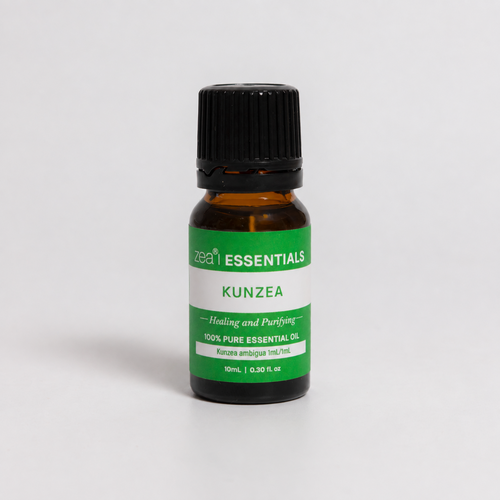
Kunzea oil is steam distilled from the leaf and twig of Kunzea ambigua, a native shrub grown in sustainable Tasmanian plantations as well as wild-harvested from coastal stands. Foliage is cut, loaded into a still, and steam is passed through it to carry the volatile oil compounds out as vapour, which is then condensed and separated from the water. It is a genuinely Australian process, from a genuinely Australian plant, and it is worth understanding in more detail than "natural" or "wild-harvested" usually tells you.
This article walks through the whole production sequence, from the plant itself to the bottle, and covers the parts of the story that most sourcing pages skip: what actually happens inside a still, why harvest timing changes the oil you get, and why a plant that used to be gathered almost entirely from the wild is now also grown in rows.
The plant behind the oil
Kunzea ambigua is a member of the Myrtaceae family, the same botanical family as Eucalyptus, Tea Tree and Manuka. It grows as an upright, spreading shrub, typically 2 to 4 metres tall depending on the population, with fine, needle-like leaves clustered densely along fibrous, furrowed stems2. From September through early November it produces masses of small, creamy-white, honey-scented flowers, with spreading stamens giving the blooms a fluffy appearance2.
The species is endemic to eastern Australia, occurring naturally along the coastal strip and adjacent plateaus of New South Wales, Victoria and north-eastern Tasmania, most commonly in heath and dry sclerophyll forest1. In Tasmania it commonly forms dense thickets on sandstone and granite-derived soils along the coast2. That coastal, low-nutrient, salt-exposed environment is part of why Tasmanian conditions suit the plant so well. Kunzea tolerates poor soils and exposure that would stress many other shrubs, which makes it a practical crop for the exposed coastal country where it is grown, and it responds readily to cultivation, propagating from seed or from semi-hardwood tip cuttings taken from late spring through early autumn2.
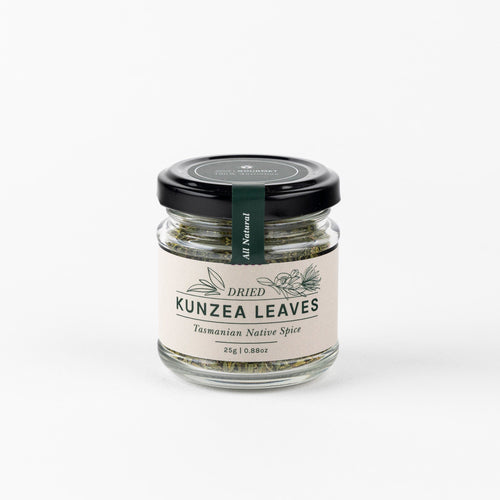
Zea also sells the plant material itself for those who want to explore it beyond the oil - Dried Kunzea Leaf is the same foliage used in distillation, simply dried rather than steamed.
The production sequence: from plant to bottle
Turning Kunzea foliage into essential oil follows a defined sequence. Here is how it works, step by step.
| Step | What happens | Why it matters |
|---|---|---|
| 1. Growing | Kunzea ambigua is established in Tasmanian plantations and also grows in wild coastal stands, tolerating poor, sandstone or granite-derived soils2. | Plantation rows give consistent, traceable supply; wild stands add genetic diversity and volume. |
| 2. Harvest | Leaf and twig are cut, typically as a shallow coppice rather than a deep cut, and timing is chosen deliberately by season3. | Cut height and season both change the amount and character of the oil recovered. |
| 3. Steam distillation | Steam is passed through the plant material rather than boiling it directly in water, carrying volatile oil compounds out as vapour4. | Keeps the plant material off direct heat, protecting the delicate oil compounds from degrading. |
| 4. Condensation and separation | The oil-laden vapour is cooled back to liquid, then oil and water separate by density since the two do not mix4. | This settling step is what yields clear, water-free essential oil. |
| 5. Quality testing | Batches are checked against physical specifications, including density, refractive index and optical rotation, before release. | Confirms the oil is genuine, consistent and free of contamination batch to batch. |
| 6. Bottling | The finished oil is bottled and, for Zea, becomes the active ingredient in the Kunzea oil range and Kunzea Pain Relief Cream. | The same oil supports both a cosmetic range and a separately regulated therapeutic product. |

How steam distillation actually works
Steam distillation is the standard method used to extract Kunzea oil, and it is worth explaining properly rather than waving at it. Plant material, in this case Kunzea leaf and twig, is loaded into a chamber. Rather than boiling that material directly in water, steam generated separately is passed through it4. The heat and moisture soften the plant tissue and release the volatile oil compounds held in its leaf glands, and as the steam rises it carries those compounds with it as vapour5.
That vapour travels into a condenser, cooled by circulating water, where it converts back into liquid. From there it runs into a separating vessel. Because oil and water do not mix and oil is less dense, the two settle into distinct layers and can be drawn off separately4. Keeping the plant material out of direct contact with boiling water, rather than simply simmering it, is the whole point of the method: it protects the more delicate oil compounds from the kind of heat damage that direct boiling can cause.
Distillation is not instant. Research trials on Tasmanian Kunzea have used runs of around five hours with a Clevenger-type apparatus3. Lighter, more volatile compounds tend to come across earlier in a run and heavier ones later, which is why the length of the run is treated as a controlled variable rather than left to chance.
Plantation and wild harvest, side by side
Kunzea oil supply comes from two sources working together: sustainable plantations and wild-harvested coastal stands. This isn't a matter of one being "purer" than the other. Wild stands have supplied the industry since it began and remain a genuine source of Tasmanian Kunzea today. Plantation growing has expanded alongside them as demand for a consistent, native Australian essential oil has grown, with dedicated plantings established to standardise supply and support a larger, more reliable industry.

That matters for two practical reasons. Plantation rows give growers control over harvest timing and cut height, both of which change the resulting oil, as the research below shows. Wild stands add genetic diversity and additional volume that a plantation alone can't replicate. Together, the two supply models give the Kunzea oil industry both consistency and resilience, rather than depending on a single source that could be disrupted by weather, disease or overharvesting.
What actually affects oil quality
Three variables do most of the work in determining what a given batch of Kunzea oil looks like: harvest timing, which part of the plant is used, and how long it is distilled.
Harvest timing and cut height. A University of Tasmania field trial compared a shallow cut (taken 0.2m above ground) against a deep cut (0.1m above ground) across a full year of seasonal harvests. The shallow cut produced 1.9 times more oil per square metre than the deep cut, at 11.79g/m2 versus 6.24g/m2, and the shallow-cut plants also grew back 50-60% faster across every season tested3. The same trial found that autumn-harvested foliage carried the highest levels of two key oil constituents, 1,8-cineole (8.23-11.40%) and viridiflorol (10.42-15.56%), of any season tested3. In practice, this means when a plant is cut and how deeply is not a minor operational detail. It is one of the biggest levers on both how much oil a hectare produces and what that oil actually contains.
Plant part. Commercial Kunzea oil is distilled from leaf and twig together rather than leaf alone, and the ratio of leaf to woody material in the load affects both yield and the balance of constituents recovered.
Distillation duration. As covered above, run length is a controlled variable rather than an incidental one, since lighter and heavier compounds come across at different points in a run.
None of this changes what Kunzea oil is used for. It changes how consistent a producer can make it batch to batch, which is exactly why quality testing against known physical specifications (density, refractive index, optical rotation) sits at the end of the production sequence rather than being left to chance.
Where the oil goes
Once distilled, tested and bottled, Kunzea oil supplies two different parts of Zea's range, each with a different regulatory status. Sold on its own as Kunzea Tasmania Essential Oil, it is a cosmetic product from the Australian native essential oils collection, used in diffuser blends and diluted topical use, with no therapeutic indications of its own.
The same oil is also the active ingredient in Kunzea Pain Relief Cream, which is a separately regulated product, registered with the Australian Register of Therapeutic Goods (ARTG) as a listed medicine (AUST L 360 331). That distinction matters: the oil and the cream share an ingredient, not a regulatory category. For more on what's actually in the oil itself, the constituent breakdown and how it compares to other native oils sits in What Is Kunzea Oil? and Kanuka vs Kunzea vs Manuka Oil, which cover composition and species comparisons this article deliberately doesn't repeat.
Frequently asked questions
Where does Kunzea oil come from?
Kunzea oil is steam distilled from the leaf and twig of Kunzea ambigua, a shrub grown in sustainable Tasmanian plantations as well as wild-harvested from coastal stands in north-eastern Tasmania1.
How is Kunzea oil extracted?
By steam distillation. Steam is passed through harvested Kunzea foliage, carrying the volatile oil compounds out as vapour, which is then condensed and separated from water by density4.
Is Kunzea wild harvested or farmed?
Both. Kunzea oil comes from sustainable Tasmanian plantations as well as wild-harvested coastal stands, working together rather than one replacing the other. Plantation growing has expanded specifically to standardise supply as demand has grown.
What part of the plant is used?
The leaf and twig. Commercial Kunzea oil is distilled from this combined foliage rather than leaf alone, and both harvest timing and cut height measurably change the yield and constituent balance of the resulting oil3.
How long does distillation take?
Commercial Kunzea oil is typically steam distilled for around five hours. Research trials have used this duration with a Clevenger-type apparatus, and distillation time itself affects which constituents, such as viridiflorol, are more fully recovered3.
References
Sources open in a new tab so you don't lose your place.
- 1. PlantNET, The NSW Plant Information Network System, Royal Botanic Gardens Sydney. Kunzea ambigua (Sm.) Druce. View source
- 2. Australian National Botanic Gardens. Kunzea ambigua growing notes. View source
- 3. University of Tasmania researchers. The Effect of the Height of Coppicing and Harvest Season on the Yield and Quality of the Essential Oil of Kunzea ambigua. Plants 12(1):20, 2023. View source
- 4. Nurhayati, R. et al. Extraction of Essential Oils from Lavandula x intermedia 'Margaret Roberts' Using Steam Distillation, Hydrodistillation, and Cellulase-Assisted Hydrodistillation. Molecules/PMC, 2022. View source
- 5. Development of High-Pressure Extraction and Automatic Steam Distillation Methods for Aronia mitschurinii, Juvenile Ginger, and Holy Basil Plants. PMC, 2025. View source