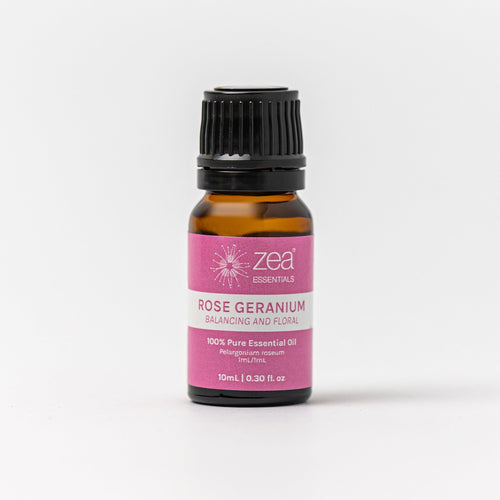
Rose Geranium essential oil comes from Pelargonium graveolens var. roseum, a scented-leaf Pelargonium in the Geraniaceae family - not a true Geranium, and not a Rose. Its leaves are steam distilled to yield an oil high in Citronellol and Geraniol, the same rose-like aroma molecules found in true rose oil, which is why it has been used in perfumery and skincare for more than a century as an affordable stand-in for genuine Rose Otto (Rosa damascena). It suits oily, combination and normal skin in a diffuser, bath or diluted topical blend, but Geraniol and Citronellol are both documented contact allergens, so it needs a patch test before regular use, especially on sensitive skin.
Botanical identity
The name "geranium oil" on a label is doing a lot of quiet misdirection. Here is what the plant actually is.
| Attribute | Detail |
|---|---|
| Botanical name | Pelargonium graveolens L'Hér. var. roseum |
| Family | Geraniaceae1 |
| Plant part used | Leaves, petals and stalks2 |
| Extraction method | Steam distillation2 |
| Native range | Southern and eastern Africa, from Zimbabwe to the Eastern Cape1 |
| Main commercial growing regions | Egypt, Réunion (historically "Bourbon"), Morocco and China |
| Aroma profile | Rosy, green, slightly minty and citrus-edged |
| Main constituents | Beta-citronellol and Geraniol, the two dominant compounds identified by GC-MS analysis of the leaf oil2 |
The confusion starts with the common name. True Geraniums (genus Geranium, sometimes called cranesbills) are a completely different plant group, mostly grown as garden perennials and not distilled for fragrance. What the fragrance and skincare industry sells as "geranium oil" or "geranium bourbon" is almost always Pelargonium, a related but distinct genus within the same Geraniaceae family1. Kew's Plants of the World Online lists Pelargonium graveolens as its own accepted species, confirming it sits in the Pelargonium genus, not Geranium1.
Rose Geranium is one product cut from Zea's essential oils range, and the Rose Geranium Essential Oil we sell is this leaf-distilled Pelargonium oil.

What it smells like, and what it blends with
Rose Geranium reads as rosy up front, with a green, leafy undertone and a faint minty-citrus edge that keeps it from smelling sweet or heavy. It is brighter and slightly sharper than true rose, which leans deeper and more velvety. That brightness is exactly what makes it useful in a blend - it lifts heavier, resinous oils without needing much volume.
It pairs well with Lavender, Bergamot, Sandalwood and other florals, which is part of why it turns up in multi-oil lifestyle blends rather than only on its own. Zea's Balance Lifestyle Blend and Heaven Scent Lifestyle Blend both draw on this kind of rosy-floral profile. Both are built for aroma rather than for any single note, which is the usual reason a floral this distinctive shows up as a supporting player.
Traditional and documented uses
Rose Geranium has a long history in perfumery and skincare, largely because of its rose-like aroma at a fraction of the cost of true rose oil. In skincare, it is traditionally used in facial oils and cleansers for its cosmetic skin-feel benefits and pleasant fragrance, and is generally considered suitable for oily, dry and combination skin types when properly diluted.
Its aromatic profile also makes it a common choice in diffuser blends aimed at a calming, balanced mood during a hectic day - see our guide to essential oils for managing stress for how oils like this one fit into a broader routine - and it is a frequent ingredient in men's grooming oils where a rounder, less sharply "floral" rose note is wanted - it's part of why it appears in blends like 2-in-1 Face + Beard Oil. These are cosmetic and fragrance uses, not therapeutic claims, and that distinction matters: essential oils sold this way are cosmetic and aromatherapy products, not registered therapeutic goods.
How to use Rose Geranium oil
Diffusion: 3-5 drops in an ultrasonic diffuser with water, run in 30-60 minute sessions rather than continuously, especially in a room with children or pets present.
Topical, diluted in a carrier oil: Rose Geranium is a mid-strength oil in terms of skin sensitivity, so keep dilution conservative:
- Face: 0.5-1% (1-2 drops per 10 mL of carrier oil, such as Zea's Unscented Massage Carrier Oil)
- Body: 1-2% (3-6 drops per 10 mL of carrier)
- Never apply undiluted essential oil directly to skin
Bath: disperse 4-6 drops in a tablespoon of carrier oil or unscented bath dispersant before adding to running water. Adding neat oil straight to bathwater lets it float undiluted on the skin.
Safety: allergen labelling, patch testing and who should be cautious
This is the section most rose-scented-oil articles skip, and it matters. Geraniol and Citronellol, the two compounds that give Rose Geranium its signature scent, are both established EU-declared fragrance allergens. Under EU cosmetic labelling rules, both must be individually listed on a product's ingredient list once they exceed 0.001% in a leave-on product or 0.01% in a rinse-off product3.
That labelling requirement exists because both compounds are documented sensitisers. A clinical case series in the journal Contact Dermatitis reported 14 cases of contact allergy linked to air-exposed (oxidised) Geraniol, with the reaction confirmed as clinically relevant to the patient's dermatitis in 11 of the 14 cases4. Reactions to Citronellol have also been documented, most often to its oxidised form after air exposure. None of this means Rose Geranium is unsafe to use - it means it should be treated the way any fragrance-active natural material should be:
- Patch test first. Dilute as above, apply a small amount to the inner forearm, and wait 24-48 hours before using more broadly. Stop immediately if redness, itching or irritation develops.
- Store away from air and light. Both key constituents oxidise on exposure to air, and the oxidised forms are more likely to trigger a reaction than the fresh oil4. Keep the bottle capped and in a cool, dark place, and don't keep an opened bottle indefinitely.
- Pregnancy and children: as with most essential oils, use a lower dilution and consult a health professional before regular use during pregnancy or with young children.
- Pets: diffused essential oils, including Rose Geranium, can be irritating to cats in particular. Keep diffusers in ventilated rooms pets can leave, and never apply diluted or neat oil directly to an animal's skin or coat.
Rose Geranium vs Geranium Bourbon vs true Rose Otto
This is the comparison almost nobody selling these oils actually draws out, mostly because the honest answer is that two of the three names describe the same plant.
| Rose Geranium | Geranium Bourbon | True Rose Otto | |
|---|---|---|---|
| Botanical genus | Pelargonium | Pelargonium (same species, different growing region/chemotype) | Rosa |
| Species | P. graveolens var. roseum | P. graveolens, historically grown on Réunion (formerly Bourbon Island) | Rosa damascena |
| Plant family | Geraniaceae | Geraniaceae | Rosaceae |
| Aroma | Rosy, green, slightly minty | Similar rosy-green profile, often prized as the finest-quality Pelargonium oil | Deep, rich, classically "rose" |
| Dominant constituents | Beta-citronellol and Geraniol2 | Beta-citronellol and Geraniol, ratio varies by growing region2 | A considerably more complex constituent profile |
| Relative cost | Affordable | Affordable to mid-range | Substantially more expensive per mL - true rose oil requires a very large volume of petals per litre of oil produced |
The practical upshot: "Geranium Bourbon" is not a different plant to Rose Geranium - it is the same species, sometimes distinguished by growing region or the ratio of Citronellol to Geraniol produced by that region's climate2. Real published GC-MS analyses show that ratio shifting meaningfully by origin, for example one comprehensive study on Egyptian-grown oil found Beta-citronellol at 29.7% and Geraniol at 14.6% as the two predominant compounds, while separate analyses of oil from other growing regions have reported different Citronellol-to-geraniol balances2. What doesn't change is the genus: it's Pelargonium either way, not a true Rose.

Frequently asked questions
Is Rose Geranium the same as Geranium oil?
Usually, yes. Most "geranium oil" sold for aromatherapy and skincare is distilled from Pelargonium graveolens, the same plant Rose Geranium comes from. True Geranium (genus Geranium) is a different, mostly ornamental plant group that isn't commercially distilled for fragrance.
Is Rose Geranium the same as Rose oil?
No. Rose Geranium is a Pelargonium; true rose oil (Rose Otto) comes from Rosa damascena, an entirely different plant family. Rose Geranium is often used as a more affordable, rose-like substitute because it shares the key aroma compounds Citronellol and Geraniol, but the two oils are chemically and botanically distinct.
What is Geranium Bourbon oil?
Geranium Bourbon refers to Pelargonium graveolens historically grown on Réunion (once called Bourbon Island). It's the same species as Rose Geranium, often regarded as a particularly fine-quality chemotype rather than a separate plant.
Can Rose Geranium oil cause an allergic reaction?
It can in sensitive individuals. Geraniol and Citronellol, its two dominant compounds, are both EU-declared fragrance allergens with documented cases of contact allergy, particularly once the oil has oxidised from air exposure. Always dilute in a carrier oil and patch test before broader use.
What does Rose Geranium blend well with?
Lavender, Bergamot and Sandalwood are classic pairings. Its bright, rosy-green profile works well lifting heavier or more resinous oils in a multi-oil blend.
Is Rose Geranium oil safe during pregnancy?
As with most essential oils, use a lower dilution and speak with a health professional before regular use during pregnancy. It should never be taken internally, and topical use should always be well diluted in a carrier oil.
References
- Pelargonium graveolens L'Hér., Plants of the World Online, Royal Botanic Gardens, Kew. powo.science.kew.org
- An In-Depth Study on the Chemical Composition and Biological Effects of Pelargonium graveolens Essential Oil, Foods (MDPI), 2024. Reports Beta-citronellol (29.7%) and Geraniol (14.6%) as the predominant GC-MS-identified compounds in leaf oil sourced from Egypt, extracted by steam distillation of leaves, petals and stalks. pmc.ncbi.nlm.nih.gov/articles/PMC10778218
- Commission Regulation (EU) 2023/1545 of 26 July 2023 amending Regulation (EC) No 1223/2009 as regards labelling of fragrance allergens in cosmetic products, Official Journal of the European Union. eur-lex.europa.eu/eli/reg/2023/1545
- Hagvall L, et al. Contact allergy to air-exposed Geraniol: clinical observations and report of 14 cases. Contact Dermatitis, 2012. pubmed.ncbi.nlm.nih.gov/22681463