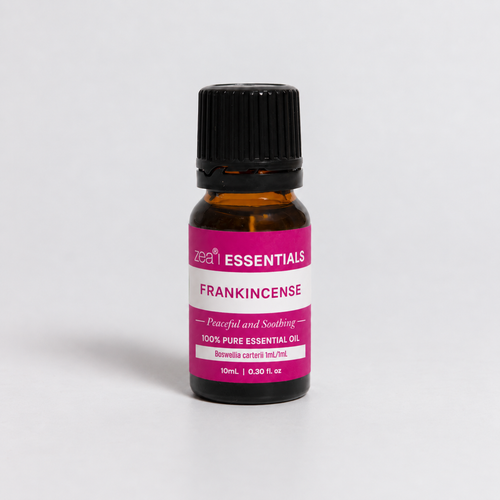
If you've gone looking for Frankincense oil, you've probably noticed the label doesn't always say the same thing. One bottle says Boswellia carterii. Another says Boswellia sacra. A blend somewhere else lists Boswellia serrata. They all smell similar, and every seller calls theirs "the real one."
Here's the direct answer. Frankincense comes from several species in the genus Boswellia, most commonly B. carterii, B. sacra, B. serrata and B. frereana. Zea's Frankincense Essential Oil is steam distilled from the resin of Boswellia carterii. And here's the one fact worth knowing before you buy anything: steam-distilled Frankincense essential oil does not contain boswellic acids, the compounds behind almost every anti-inflammatory claim you'll read about frankincense online. Those compounds are found in frankincense resin extracts and CO2 extracts, not in the essential oil you diffuse or dab on your wrist.1

This guide sets out the species you'll actually find on shelves, what's really in the oil chemically, how to tell a pure bottle from an adulterated one, and how the oil is traditionally used in aromatherapy - all with the source named, so you can check it yourself.
How many types of frankincense are there?
There is no single agreed number, and that is the first clue about how messy this genus is. Kew's Plants of the World Online currently lists 25 accepted species in Boswellia,2 while a 2022 genome study of Boswellia sacra states that "the genus Boswellia consists of 24 species".6 Other published counts run lower again. The disagreement is not sloppiness; it reflects genuine, ongoing revision in a genus whose members hybridise, vary regionally and have often been described from material of uncertain origin. Either way, only a handful of those species are traded commercially as essential oil or resin. The table below covers the ones you're most likely to see on a label.
| Common name | Botanical name | Where it grows | Typical use | Notes |
|---|---|---|---|---|
| Frankincense (Zea's) | Boswellia carterii | Somalia and the Horn of Africa | Essential oil for aromatherapy, diffusing, skincare blends | Sweet, balsamic aroma. The species Zea steam distils. |
| Boswellia sacra | Boswellia sacra | Southern Arabia (Oman, Yemen) | Essential oil and resin, prized in the Middle East | Kew's Plants of the World Online and World Flora Online currently treat this as the same species as B. carterii; much of the chemistry and botany literature treats them as distinct. Unsettled - see below. |
| Indian Frankincense | Boswellia serrata | India | The species behind most oral Boswellia supplements | Different species, different product category - see the boswellic acid section below. |
| Maydi / Coptic Frankincense | Boswellia frereana | Somalia | Chewed as a resin in parts of the Horn of Africa; also distilled | Distinct aroma profile from B. carterii; not well documented in the wider aromatherapy literature. |
| Boswellia papyrifera | Boswellia papyrifera | Ethiopia, Eritrea, Sudan | Not well documented in aromatherapy retail; more commonly a resin/incense trade species | Not well documented as a standalone essential oil in the consumer market. |
Is Boswellia carterii the same as Boswellia sacra?
Honestly, this is a live disagreement, not a settled fact - and we'd rather tell you that than pretend otherwise. Kew's Plants of the World Online and World Flora Online, two of the major reference databases for plant taxonomy, currently list Boswellia carterii as a synonym of Boswellia sacra.2 At the same time, a good part of the chemistry and botanical literature treats them as two separate species: B. carterii Birdwood, originally described from Somalia, and B. sacra Flückiger, described from southern Arabia. Researchers arguing for the distinct-species position point to differences in aroma, resin colour, physical and chemical analysis, and geographic distribution.2
We're not going to pick a side here, because the question genuinely hasn't been settled by the people whose job it is to settle it. What we can tell you plainly is which species Zea's own oil is distilled from, and that's Boswellia carterii.
Why does this matter to you as a buyer rather than a botanist? Mostly because it explains why you'll see two different Latin names on oils that smell and behave almost identically, and why neither seller is necessarily wrong. If a brand lists B. sacra and another lists B. carterii, that difference alone doesn't tell you which oil is more "authentic" - the taxonomy debate cuts both ways. What's more useful to check is where the resin was sourced, how it was distilled, and whether the seller can speak plainly to the species question rather than papering over it.
Which type of frankincense should you buy?
There's no strict hierarchy where one species is objectively "better" than another - it comes down to use case and aroma preference. If you want an essential oil for diffusing, aromatherapy blending or a skincare routine, Boswellia carterii or B. sacra oils are the standard choice, and they're what most reputable essential oil brands, including Zea's Frankincense Essential Oil, are steam distilled from.
If what you're actually after is oral Boswellia supplementation - the kind studied for joint comfort in supplement research - that's a different product category built around Boswellia serrata resin extract, not an essential oil. It's worth knowing the difference before you buy, because the two are marketed in very similar language and they are not interchangeable products.
For blending, Frankincense pairs well with other base and middle notes such as Lavender and Cedarwood, which is part of why it appears in blends like Zea's Calming Lifestyle Blend. If you're building your own blend, our Ingredient Glossary is a good place to check what a note actually means before you commit a bottle to it.

What is actually in frankincense oil?
A 2022 peer-reviewed study compared the volatile compounds in lab-distilled versus commercial Boswellia carterii essential oils to establish an authentication profile.3 In the lab-distilled reference samples, the dominant compounds were:
| Compound | Concentration (lab-distilled) |
|---|---|
| alpha-Pinene | 31.8-33.3% |
| Limonene | 10.1% |
| alpha-Thujene | 9.1-9.2% |
| p-Cymene | 5.5-5.6% |
| Myrcene | 3.2-3.4% |
| Sabinene | 3.2-3.5% |
| beta-Pinene | 2.1-2.4% |
| (E)-beta-Caryophyllene | 1.8-1.9% |
These figures are from the study's lab-distilled reference samples, produced specifically to characterise authentic oil - they're a reference point for what the chemistry looks like, not Zea's own batch specification.
Does frankincense oil contain boswellic acid?
No - and this is the single most useful thing to understand before you read anything else about frankincense online. Boswellic acids are pentacyclic triterpenes, a class of compound with molecular weights around 470 and boiling points in the 500-600°C range. That makes them far too heavy and non-volatile to carry over during steam distillation.1 They're found in substantial concentrations - in some cases up to 60% - in frankincense resin extracts and in CO2 extracts, which are extracted by an entirely different method. They are not found in steam-distilled essential oil.
Aromatherapy researcher Robert Tisserand, reviewing the evidence at the Tisserand Institute, put it directly: "So far there is no reliable report of BAs in any Frankincense oil produced using normal distillation parameters."
He notes that boswellic acids don't show up in GC-MS analysis of frankincense essential oils, and that any trace amount detectable by more sensitive HPLC testing "will likely have no influence on the therapeutic action of the oil." One study that claimed to find roughly 3% boswellic acid content used vacuum distillation with a 12-hour distillation time and post-distillation fractionation - a very different process from standard steam distillation - and the study's own author has since said the published description of that process was inaccurate.1
This matters for three reasons. First, it's the clearest way to answer the "which type is best for pain" and "is frankincense anti-inflammatory" questions honestly: nearly every page online blurs research on oral Boswellia supplement extracts into claims about essential oil, and the chemistry says those are two different things. Second, it explains plainly why we don't make anti-inflammatory or pain-relief claims about Frankincense Essential Oil - it's a cosmetic aromatherapy product, not a therapeutic good, and it isn't listed on the Australian Register of Therapeutic Goods (ARTG). Third, and importantly, we want to be clear that we are not saying Zea's Frankincense Essential Oil delivers the effects studied for boswellic acid extracts - that research applies to a different product category entirely, and we don't want you to buy our oil expecting resin-extract results.
This is also why Boswellia serrata is worth knowing by name: it's the species most oral Boswellia supplements are made from, and it's the one behind the joint-comfort supplement research you may have seen referenced elsewhere.
How to tell if frankincense oil is pure
The same 2022 study that measured the chemical profile above also tested 21 commercially available frankincense oils for authenticity - and the results are worth knowing if you've ever searched "100% pure frankincense oil" and wondered what that actually guarantees.3 Every single one of the 21 commercial samples showed some form of adulteration or contamination. Named adulterants included synthetic limonene, octyl acetate and castor oil, along with cross-species contamination from other Boswellia species being blended in without disclosure.
The study identified incensole and serratol as biomarker compounds specific to authentic Boswellia carterii oil - and only 2 of the 21 commercial samples tested contained both. The researchers also found that eight chiral terpenoid compounds show characteristic enantiomeric distributions (essentially, mirror-image molecular ratios) in genuine oil, and these ratios shift in a detectable way when the oil has been adulterated.3
To be clear: this study didn't test Zea's oil specifically, and we're not making a comparative purity claim against any named or unnamed competitor. What it does tell you is that species labelling and lab testing genuinely matter in this category, because a label alone doesn't guarantee what's in the bottle. A full GC-MS breakdown is the only reliable way to confirm authenticity, and we've written a separate guide on exactly how that testing works.4

How frankincense is used in aromatherapy
Frankincense sits at the base to middle of the fragrance pyramid, meaning it's long-lasting and grounding in a blend rather than a top note that fades fast. Its use in ritual and meditation contexts goes back thousands of years, and that history is part of why it remains a popular choice for people building a wind-down or meditation practice today - not because of any specific therapeutic claim, but because of the association and the aroma itself.
For general aromatherapy use, the National Association for Holistic Aromatherapy (NAHA) recommends a dilution of 1-5% for typical adult use, and 0.5-2.5% for sensitive populations such as children, the elderly, or anyone with sensitive skin.5 In a diffuser, a few drops is standard; for topical blending, dilute in a carrier oil at the NAHA ratio before applying to skin.
Frankincense blends well with woody and floral notes - Lavender, Cedarwood and Sandalwood are common pairings, all available in Zea's Essential Oils collection. It's also one of the components in Zea's Calming Lifestyle Blend alongside Lavender, Cedarwood and Ylang Ylang, if you'd rather start with a pre-built blend than formulate your own.
A diffuser is the simplest way to start - a few drops in water is enough to fill a room with a base note that lingers far longer than a citrus or mint oil would. If you're new to using Frankincense specifically for a wind-down or meditation practice, try it on its own first before layering it into a blend, so you get a clear sense of its aroma before combining it with anything else. Because it's a base note, a little tends to go further than expected - start light and build up rather than the reverse. If you're building a broader Tasmanian botanical collection, Zea's Kunzea Oil is a different aromatic profile entirely and worth exploring alongside Frankincense rather than in place of it.
Safety
- Always dilute in a carrier oil before applying to skin - do not apply undiluted.
- Patch test on a small area of skin before wider use.
- Keep away from eyes and mucous membranes.
- Not for internal use.
- If you're pregnant, breastfeeding, or have a medical condition, consult your GP before using any essential oil.
- Keep essential oils away from pets - cats in particular are highly sensitive to many plant compounds. We haven't found a frankincense-specific pet safety study we're comfortable citing here, so if pet safety is a concern, general essential oil and pet safety guidance is the better resource to check.
Frequently asked questions
How many types of frankincense are there?
Published counts differ: Kew's Plants of the World Online lists 25 accepted species, a 2022 genome study says 24, and other sources give fewer. Only a handful are traded commercially. The main ones you'll see on essential oil or resin labels are Boswellia carterii, Boswellia sacra, Boswellia serrata, Boswellia frereana and Boswellia papyrifera.
Which type of frankincense is best?
There isn't a single "best" species - it depends what you're using it for. For diffusing, blending and skincare, B. carterii or B. sacra essential oil is standard. For oral supplementation aimed at joint comfort, that's a different category built on B. serrata resin extract, not an essential oil.
Is frankincense the same as myrrh?
No. Both are aromatic tree resins traditionally traded together and often paired in blends, but they come from different genera - Frankincense from Boswellia species, Myrrh from Commiphora species. They have different aroma profiles and different chemistry.
Does frankincense oil contain boswellic acid?
No, not in any reliably reported amount. Boswellic acids are too heavy to carry over in standard steam distillation and are instead found in frankincense resin extracts and CO2 extracts.1
What does frankincense smell like?
Sweet, balsamic and slightly woody, with a warm, resinous depth. It sits as a base note in a blend, meaning the scent lingers longer than lighter, top-note oils.
Can you put frankincense oil on your skin?
Yes, once properly diluted in a carrier oil - never apply essential oil undiluted directly to skin. Patch test first.
Is frankincense oil safe in pregnancy?
Speak to your GP before using any essential oil during pregnancy. This isn't something we're going to answer definitively here - it depends on individual circumstances your doctor can assess.
References
Sources open in a new tab so you do not lose your place.
- 1. Tisserand Institute. Does Frankincense oil contain boswellic acid? View source
- 2. Plants of the World Online, Royal Botanic Gardens, Kew. Boswellia carteri Birdw. View source
- 3. Ojha PK, Poudel DK, Rokaya A, Satyal R, Setzer WN, Satyal P. Comparison of Volatile Constituents Present in Commercial and Lab-Distilled Frankincense (Boswellia carteri) Essential Oils for Authentication. Plants. 2022;11(16):2134. doi:10.3390/plants11162134. View source
- 4. Zea Health Library. How essential oil purity is verified. View article
- 5. National Association for Holistic Aromatherapy (NAHA). Safety information: dilution guidelines. View source
- 6. Khan AL, Al-Harrasi A, Wang J-P, et al. Genome structure and evolutionary history of frankincense producing Boswellia sacra. iScience. 2022;25(7):104574. doi:10.1016/j.isci.2022.104574. View source