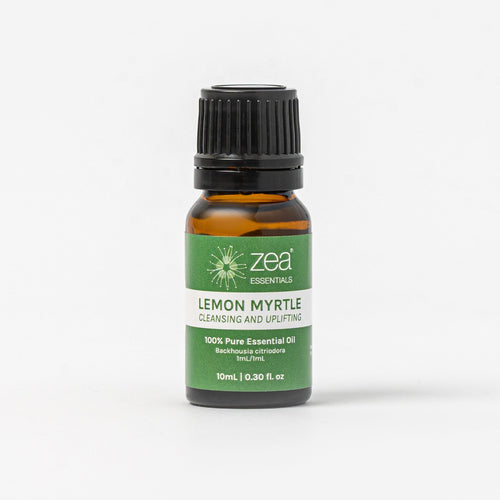
Lemon Myrtle is the most intensely lemon-scented plant in the world, and it is not a citrus at all. It is an Australian rainforest tree, Backhousia citriodora, native to the subtropical forests of south-east Queensland, and its leaves carry more citral than any other known botanical source, including lemongrass and lemon itself.
That single fact explains almost everything about the oil: why it smells sharper and sweeter than lemon peel, why it works so well as a natural cleaner, and why it needs to be diluted more carefully than most oils on your shelf.
This guide covers what Lemon Myrtle oil is, what the research supports it for, how to use it safely at the right dilution, how to blend it, and where it turns up across the Zea Essentials range.
Leaf or Oil? The Difference Matters
Lemon Myrtle reaches you in two quite different forms, and they are not interchangeable.
- The leaf, fresh or dried, is a food. It is what goes into seasoning, baking and herbal tea, and it is safe to eat. You will find it in the Zea Gourmet range.
- The essential oil is steam distilled from that leaf and is roughly a hundred times more concentrated. It is for aromatic and diluted topical use only, and should never be swallowed.
This guide is about the oil. Where the leaf comes up below, it is flagged as the leaf.
What Is Lemon Myrtle Oil?

Lemon Myrtle essential oil is steam distilled from the leaves of Backhousia citriodora, an evergreen tree in the Myrtaceae family, the same family as eucalyptus, tea tree and Kunzea. The leaves yield roughly 1 to 3% oil by fresh weight.1
The tree is endemic to Australia. It grows naturally in the coastal rainforest of south-east Queensland and northern New South Wales, and is now cultivated commercially in plantations across the region.
Traditional and Culinary Use (the Leaf)
Lemon Myrtle has been used by Aboriginal peoples of the Queensland rainforest for thousands of years, both as a food flavouring and in traditional healing practice. The leaf remains one of the best known Australian bush foods, used fresh or dried to season seafood, chicken and baked goods, and brewed as a herbal tea.
Citral is a permitted food flavouring with GRAS status, which is why Lemon Myrtle turns up in soft drinks, kombucha, confectionery and spice blends.1 It appears in our own Zea Gourmet pantry range as a native seasoning. That is the leaf, not the oil covered in the rest of this guide.
A closer look at Lemon Myrtle, from the leaf to the bottle.
Why Citral Is the Whole Story
Citral is not one compound but two isomers, geranial and neral, and it is what your nose reads as "lemon". Lemon Myrtle contains it at a concentration nothing else comes close to.
| Source | Typical citral content |
|---|---|
| Lemon Myrtle | 80 to 98% |
| Lemongrass | 60 to 90% |
| Lemon (cold pressed peel) | Around 2 to 5% |
Lemon oil is dominated by limonene, not citral, which is why the two smell related but distinct. Lemon is bright and peely. Lemon Myrtle is rounder, sweeter and considerably more intense, closer to lemon sherbet.1
There are two chemotypes of the tree. The citral chemotype is the one grown commercially and the one you will find in any Lemon Myrtle oil sold for aromatherapy. A rarer citronellal chemotype exists, with a markedly different profile.1
Essential Oil Profile

- Botanical name: Backhousia citriodora
- Also known as: Lemon Scented Myrtle, Lemon Scented Ironwood, Sweet Verbena Tree
- Family: Myrtaceae
- Plant part and method: Leaves, steam distilled
- Country of origin: Australia
- Perfumery note: Top
- Aroma strength: Very strong
- Aroma: Sharp, sweet, unmistakably lemon, with a clean herbaceous base
- Main constituents: Geranial (46 to 61%), neral (32 to 40%), isogeranial, isoneral, with small amounts of linalool, citronellal and myrcene
- Blends with: Citrus, mint, wood and floral oils
Benefits and Uses of Lemon Myrtle Oil
1. A Genuinely Powerful Natural Cleaner
This is the use with the strongest evidence behind it. Lemon Myrtle oil has demonstrated broad-spectrum antimicrobial activity in laboratory testing against Staphylococcus aureus, Escherichia coli, Pseudomonas aeruginosa, Candida albicans, MRSA, Klebsiella pneumoniae and Aspergillus niger, with results comparable to or exceeding tea tree oil.23
Later work found it also disrupts bacterial biofilms, the stubborn films that form on surfaces, which is attributed to the high citral content.3
This is why it earns its place in surface sprays, laundry and bin deodorising rather than just smelling nice.
2. Diffusing for Focus and Freshening a Room
Lemon Myrtle is bracing rather than relaxing. Most people find it useful in a study, a home office or a kitchen, and too stimulating for a bedroom at night. Two to four drops in a diffuser is plenty; it is one of the few oils where more is genuinely worse.
3. Lifting a Flat Mood
"The best description I can give for my first impression of Lemon Myrtle is WOW. What a bright happy essential oil. The fresh lemon scent really clears out the cobwebs of the mind."
Mark Webb, Bush Sense: Australian Essential Oils and Aromatic Compounds5
Aromatherapy literature consistently places Lemon Myrtle with the uplifting citrus-type oils, used for mental fatigue and low motivation. It is worth being straight about the evidence here: this rests on traditional aromatherapy practice and personal experience rather than clinical trials, unlike the antimicrobial work above.
4. Seasonal and Congestion Support
The sharp, clearing aroma makes it a common choice in steam inhalations and chest balms through winter. You will find it in our Vapour Rub and Refresh Shower Steamer for exactly this reason.
5. Repelling Insects
Citral-rich oils are well established as insect repellents, and Lemon Myrtle being the densest natural citral source makes it an obvious candidate. Note that repellency from any essential oil is short-lived compared with registered repellents, so reapplication is needed.
6. Anti-Inflammatory and Antioxidant Activity
Laboratory studies have shown Lemon Myrtle extract suppressing inflammatory markers including IL-6 and TNF-alpha in a concentration-dependent way, alongside measurable antioxidant activity.1 This is early cell-level research, not evidence of a treatment effect in people, but it is a plausible mechanism behind the traditional uses.
How to Use Lemon Myrtle Oil Safely
This is the part most articles skip, and with Lemon Myrtle it matters more than with almost any other oil. The same citral that makes it effective also makes it sensitising on skin at higher concentrations.
Keep topical use under 1%. Research on human skin found citral was the component absorbing through the skin, and that a formulation at 1% Lemon Myrtle oil was low in toxicity and suitable for topical products.4 Above roughly 1%, the risk of skin sensitisation rises.1
In practice, 1% is about 6 drops per 30ml of carrier oil. For comparison, a general body massage blend of most other oils sits at 2 to 3%. Lemon Myrtle should be half to a third of that.
- Never apply it neat. Always dilute in a carrier such as our Unscented Massage Carrier Oil
- Patch test first on the inner forearm and wait 24 hours, particularly if you have sensitive or reactive skin
- Sensitisation is cumulative. A blend that was fine for weeks can start to cause a reaction, which is why staying under 1% matters even if you have had no trouble so far
- Do not take it internally. Culinary lemon myrtle leaf is a different product from the concentrated essential oil
- Avoid on damaged or broken skin, and keep it away from eyes and mucous membranes
- Speak to your health professional before use if you are pregnant, breastfeeding, or using it with children
- Store it well. Citral oxidises with heat, light and air, and oxidised citral is more sensitising. Keep the bottle tightly closed, cool and dark, and replace it if the aroma turns harsh
Blending With Lemon Myrtle
Lemon Myrtle is a top note with a very loud voice. Treat it as an accent rather than a base: one drop of Lemon Myrtle will hold its own against three or four drops of almost anything else.
- With Australian natives: Kunzea, Nerolina and Coastal Tea Tree for a clean, distinctly Australian profile
- With citrus: Sweet Orange to round off the sharpness
- With florals: Lavender to soften a blend for evening use
- With woods: Buddha Wood or Vetiver to anchor it and slow the fade
Diffuser Blends to Try
- Clear head: 2 drops Lemon Myrtle, 3 drops Kunzea, 2 drops Sweet Orange
- Winter air: 2 drops Lemon Myrtle, 3 drops Coastal Tea Tree, 2 drops Eucalyptus
- Wind down: 1 drop Lemon Myrtle, 4 drops Lavender, 2 drops Nerolina
DIY Multipurpose Surface Spray
In a 500ml spray bottle, combine 2 cups distilled water, 1 cup white vinegar, 20 drops Lemon Myrtle, 20 drops Coastal Tea Tree, 20 drops Sweet Orange and a solubiliser such as Polysorbate 20 or Solubol. Shake before each use. Avoid vinegar on porous stone such as granite or marble, and patch test any new surface.
Laundry Freshener
Three drops in the washing machine with towels leaves a clean, bright aroma. This is a rinse-off use, so the dilution guidance above does not apply in the same way.
Where You Will Find Lemon Myrtle Across the Zea Range
Lemon Myrtle is one of those ingredients that earns a place in a formulation rather than just a fragrance. Beyond the pure oil, it appears in:
- Vapour Rub Natural Chest Balm, where it sits alongside the clearing oils for winter congestion
- Refresh Shower Steamer, for a sharp lift first thing in the morning
- Kunzea Concentrated Massage Oil, already blended at a safe dilution
- Immunity Lifestyle Blend, a ready-made diffuser blend
- Third Eye Chakra Blend, where the clarity note does the work
- Kunzea Relief Tea, which uses the dried leaf, not the essential oil
If you would rather not measure dilutions yourself, those blends and balms are the simplest way to use Lemon Myrtle, because the formulation work is already done.
The Short Version
Lemon Myrtle is the densest natural source of citral on the planet, which makes it the most lemon-smelling oil you can buy and a genuinely effective natural cleaner with real laboratory evidence behind it. The same chemistry means it needs respect on skin: keep topical blends under 1%, patch test, and store it away from heat and light.
Used as an accent rather than a headline, it will lift almost any blend you put it in.
Shop Lemon Myrtle Essential Oil, wild Australian and steam distilled from the leaf.
About the Author
Michelle Brass, ND
Michelle has spent more than 25 years in the natural health industry as a practising naturopath, and takes an integrative view of health, drawing on both traditional and conventional approaches. She has worked with essential oils, and Kunzea in particular, with thousands of clients, and continues to trial and test new products alongside them.
References
Sources open in a new tab so you do not lose your place.
- 1. Saifullah B, et al. Backhousia citriodora F. Muell. (Lemon Myrtle), an Unrivalled Source of Citral. Foods, 2021. View source
- 2. Hayes AJ, Markovic B. Toxicity of Australian essential oil Backhousia citriodora (Lemon myrtle). Part 1. Antimicrobial activity and in vitro cytotoxicity. Food and Chemical Toxicology, 2002. View source
- 3. Chemical Composition, Antioxidant, Antibacterial and Antibiofilm Activities of Backhousia citriodora Essential Oil. Molecules, 2022. View source
- 4. Hayes AJ, Markovic B. Toxicity of Australian essential oil Backhousia citriodora (Lemon myrtle). Part 2. Absorption and histopathology following application to human skin. Food and Chemical Toxicology, 2003. View source
- 5. Webb M. Bush Sense: Australian Essential Oils and Aromatic Compounds. Mark Webb, 2000.
This article is general information only and is not a substitute for individual medical advice. Essential oils are for external and aromatic use only. If symptoms persist, talk to your health professional.