
The island
Off the north-east tip of Tasmania, out in Bass Strait, there is an island where Kunzea grows wild along the coast in dense thickets. Kunzea ambigua usually reaches two to four metres. Ben reckons the plants on Flinders get to six, and puts it down to the growing conditions.
Aboriginal communities in Tasmania used Kunzea for centuries, as an insect repellent and to treat everyday aches and ailments. Oral histories carry that knowledge, and it long predates anyone putting the oil in a bottle.
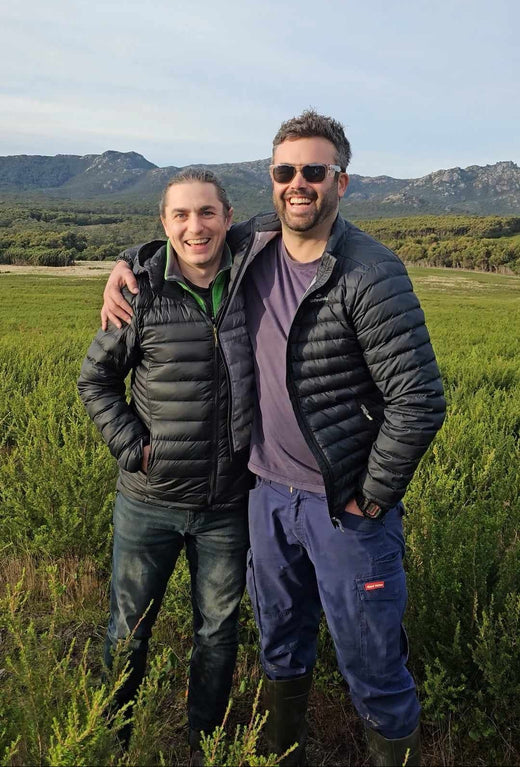
Almost all the Kunzea in our products comes from one fifty acre block on that island, coast on one side and a mountain range behind it.
It started with Steve
Ben's father spent thirty years in the Australian essential oil industry and built a network right across it. The first time Steve came to Flinders Island and saw the Kunzea growing along the coast, he decided that was where he wanted to spend the rest of his working life.
Between them, father and son raised more than a million seedlings. They planted thirty of the fifty acres, and turned a dairy that had milked cows through the 1950s into a distillery. It is now the most southerly native oil distillery in the country, and locals still wander in and get sentimental about the building.
Steve has since passed away. Ben runs it now, with John, a local who has been alongside them for years.
"John's been fantastic and together we're determined to continue to build Dad's vision."
Why the island's oil is good
Kunzea ambigua grows naturally on sandy coastal soils, and Flinders Island is largely that. Sand, salt air, a mountain range and not much else. The island sits at forty degrees south, in the band of westerlies known as the Roaring Forties, so the weather arriving over the plantation has come a long way across open ocean to get there. Fewer than a thousand people live on it.
Tasmania has also had a moratorium on releasing genetically modified organisms into the environment since 2001, currently running to 2029. That is a state-wide position rather than anything we arranged, and it is a good part of why Tasmanian growing country carries the reputation it does.
The result is measurable rather than romantic. Independent testing of a batch of our oil at Southern Cross University returned 43.7% alpha-pinene, 11.2% 1,8-cineole and 10.9% viridiflorol. Viridiflorol is the one we watch most closely, because it is the constituent most studied for anti-inflammatory activity, and a longer distillation run lifts it further.
Growing it
The plants are slow grown, and Ben has noticed something odd along the way. Kunzea from different parts of the island yields oil of different character. Same species, same island, different result. He suspects the environment is turning up in the plant's genetics, which would mean where a shrub sits on that island changes what comes out of the still.
Some of what we buy is cut from the plantation and some from wild stands. Planting was always the intention, so that supply never depended on stripping what grows naturally.
Making the oil
The work itself is unglamorous. Freshly cut leaves and branchlets go into a large still, steam is pumped up through them, and the aromatic compounds lift off as vapour. That vapour runs through a condenser cooled with water from the local wetlands and comes back as liquid. Oil and water separate, the oil floats, and it gets siphoned off the top.
Two hours of cutting takes about three more hours to distil, and yields a litre or two of oil.
There is no synthetic version of Kunzea to fall back on. When a season is poor, it is poor. Every tube of Kunzea Pain Relief Cream traces back to that island, that plantation, and the two blokes working it.


