Eucalyptus essential oil isn't one oil. "Eucalyptus oil" on a label can mean the steam-distilled leaf oil of any of more than a dozen commercially distilled Eucalyptus and Corymbia species, and the differences aren't cosmetic. Eucalyptus globulus and E. radiata are dominated by the compound 1,8-cineole and smell sharp and medicinal. E. dives, the species behind Zea's Peppermint Gum oil, is distilled in several chemotypes and the best known of them is built around piperitone rather than cineole, and lemon-scented gum, botanically Corymbia citriodora and no longer classified as a true eucalypt, smells nothing like either because its oil is built around citronellal, not cineole. Used correctly - diffused, diluted for topical use, or added to a steam - eucalyptus oil is a well-established aromatherapy staple. Swallowed, even a small amount, it is a genuine poisoning risk, particularly for young children.2
Botanical identity: five oils, one name
Eucalypts are one of the most species-rich plant groups Australia has, and eucalyptus oil production has drawn on well over a dozen of them since the industry began. The table below sets out the five species most relevant to a Zea customer: the two workhorse medicinal oils, the highest-cineole industrial species, Zea's own Peppermint Gum, and the lemon-scented oil that isn't botanically a eucalyptus at all.
| Species | Common name | Family | Dominant constituent(s) | Aroma |
|---|---|---|---|---|
| Eucalyptus globulus | Tasmanian blue gum | Myrtaceae | 1,8-cineole (dominant)1 | Sharp, camphoraceous, medicinal |
| Eucalyptus radiata | Narrow-leaved peppermint | Myrtaceae | 1,8-cineole, with phellandrene and piperitone1 | Softer, rounder, less sharp than globulus |
| Eucalyptus polybractea | Blue mallee | Myrtaceae | 1,8-cineole (dominant, with pinene)1 | Intensely sharp and clean - the highest-cineole oil in the group |
| Eucalyptus dives (Zea's Peppermint Gum) | Broad-leaved peppermint | Myrtaceae | Sold in three chemotypes: piperitone, phellandrene, and a cineole variant at 60-75% cineole1 | Minty, herbaceous, noticeably less medicinal than globulus |
| Corymbia citriodora (formerly Eucalyptus citriodora) | Lemon-scented gum | Myrtaceae | Citronellal dominant, 65-80%1 | Sweet, lemon, closer to citronella than to camphor |
All five are steam-distilled from leaf and terminal branchlets, and all are Australian in origin, though several are now cultivated commercially outside Australia as well. The genus split matters more than it looks: in 1995, taxonomists Ken Hill and Lawrie Johnson moved lemon-scented gum out of Eucalyptus and into a new genus, Corymbia, based on bark and fruit differences.3 "Lemon eucalyptus oil" is still the common trade name, but it comes from a tree that is no longer classified as a eucalypt at all - and chemically, its citronellal-driven profile has nothing in common with the cineole oils above. This is the single most useful thing to know before buying "eucalyptus oil" for a specific purpose: read the species, not just the front label.
What it smells like, and what it blends with
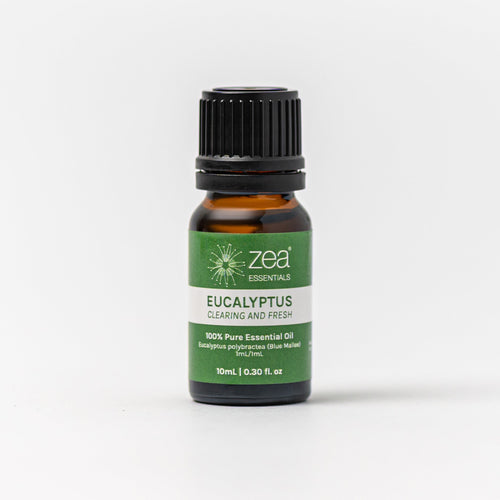
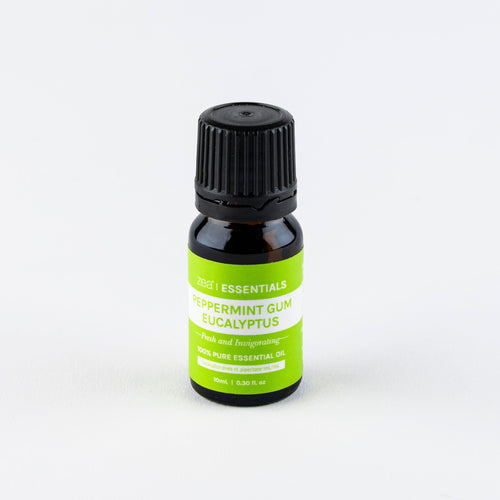
Zea's Eucalyptus Essential Oil is distilled from Eucalyptus globulus/radiata-type stock and carries the sharp, cool, slightly medicinal scent most people mean when they say "eucalyptus" - the smell of a bushfire-cleared gully or a hospital corridor, in the best way. It blends well with other sharp, clean oils: Peppermint Gum, tea tree, rosemary and lemon-type oils all sit comfortably alongside it in a diffuser blend. Zea's Peppermint Gum Eucalyptus Essential Oil (E. dives) reads differently on the nose - softer, herbaceous, closer to a minty garden shrub than a hospital shelf - which makes it a gentler choice for a bedroom diffuser blend where a sharp camphor note would be too much.

Traditional and documented uses
Eucalyptus oil has one of the longest continuous industrial histories of any Australian export. Commercial distillation traces to 1854, when Victorian pharmacist Joseph Bosisto - encouraged by the Victorian Government Botanist, Baron Ferdinand von Mueller - established a still on Dandenong Creek, Victoria, to distil the oil of E. radiata. Bosisto's oil was exhibited at seventeen international exhibitions between 1854 and 1891 and helped establish oil distilling more widely in New South Wales and Tasmania through the 1880s.1 The industry that grew from that one still went on to supply the world for decades, with Australia holding around 90% of the global export market through the 1920s.1
In aromatherapy, cineole-rich eucalyptus oils are traditionally diffused for a fresh, clearing atmosphere, added to a warm steam bowl as a personal-care ritual, or diluted into a chest or muscle rub. 1,8-cineole itself has been studied in laboratory research for anti-inflammatory activity in respiratory tissue, including its effect on immune signalling pathways in lung cells.4 That is laboratory-level mechanistic research, not a claim that Zea's Eucalyptus Essential Oil treats, cures or prevents any illness - it is sold and should be used as an aromatherapy and personal-care product, not a medicine. Zea's Natural Vapour Rub is a separate, purpose-formulated chest balm; check its own product page for what it is intended for rather than assuming this oil and that balm share a claim.
How to use eucalyptus oil safely
- Diffusion: 4-6 drops in a standard ultrasonic diffuser reservoir. Run in a well-ventilated room, and keep sessions to 30-60 minutes rather than continuous all-day diffusion.
- Topical, diluted: Eucalyptus oil should never be applied undiluted to skin. A common aromatherapy dilution is 2-3 drops of essential oil per 10mL of a carrier oil (such as sweet almond or jojoba) for adult use - patch test on the inner forearm first and wait 24 hours before wider use.
- Steam inhalation: 2-3 drops in a bowl of hot (not boiling) water, breathed with eyes closed for a few minutes at a comfortable distance. Never lean directly over very hot water.
- Bath: Disperse a few drops in a tablespoon of carrier oil or an unscented dispersant before adding to bathwater - neat essential oil sits on the water's surface and can irritate skin directly.
- On fabric, not skin: A drop on a pillow corner or a silk pillowcase edge (never the sleeping surface itself) is a low-dilution way to enjoy the scent overnight.
Safety: the honest section
This is the part of any eucalyptus oil article that matters most, and it is worth saying plainly: eucalyptus oil must never be swallowed. It is not a food or a medicine to be taken by mouth, and it is genuinely toxic if ingested. The Royal Children's Hospital's clinical poisoning guidelines note that as little as 2-3mL of pure oil can cause significant central nervous system depression - drowsiness, dizziness and loss of coordination - in a child, and doses of 5mL or more can cause coma. Symptoms typically appear within 30 minutes to four hours of ingestion.2 A published case report describes a 17-month-old who swallowed roughly half a millilitre from an unsecured household bottle and became drowsy, requiring hospital treatment. That child did not have seizures, and the point of the case is how small the quantity was.5
Practical precautions:
- Store bottles out of reach and out of sight of children, ideally in a locked cabinet - not a bathroom shelf or bedside table.
- Never add essential oil to a drink bottle, water glass or food, and never suggest it as something to be swallowed for any reason.
- Keep well diluted for topical use, and always patch test first - undiluted oil can irritate or sensitise skin.
- Avoid direct use on or near the face of infants and very young children; several aromatherapy bodies advise against eucalyptus oil around babies and toddlers altogether given how easily airway irritation and accidental ingestion can occur at that age.
- If pregnant, breastfeeding, or managing a health condition, check with a GP or pharmacist before regular use.
- Keep away from cats in particular - many essential oils, eucalyptus included, are poorly tolerated by cats due to how they metabolise plant compounds.
- If ingestion happens or is suspected, call the Poisons Information Centre on 13 11 26 (Australia) immediately, or emergency services if the person is unconscious or having a seizure. Do not wait for symptoms to appear.

Globulus vs radiata vs Peppermint Gum vs lemon-scented: which one do you actually want?
This is the confusion this article exists to clear up. Four oils, all sold as "eucalyptus", all doing different jobs:
- E. globulus and E. polybractea: the sharpest, most cineole-dominant oils. Choose these for a strong, clearing diffuser scent - they are the most "medicinal" smelling of the group.1
- E. radiata: a gentler cineole oil - similar character to globulus but rounder, with less of the sharp edge. A good middle ground for daily diffuser use.1
- E. dives (Zea's Peppermint Gum): chemically the odd one out of the cineole group - built around piperitone, not cineole - so it smells minty and herbaceous rather than medicinal. Choose this over globulus when a sharp camphor note feels too strong, especially for evening or bedroom use.1
- Corymbia citriodora ("lemon eucalyptus"): not botanically a eucalypt, and chemically built around citronellal rather than cineole. If a product description mentions "lemon eucalyptus" for its citrus, uplifting character, this is the species doing the work - it will not deliver the sharp, clearing scent people associate with classic eucalyptus.3
Cajeput oil sits in a related but genuinely different category again - it comes from Melaleuca cajuputi, in the same broad Myrtaceae family as eucalyptus and tea tree, but it is not a Eucalyptus or Corymbia species at all. If you're comparing the two, our Cajeput Oil guide covers that oil's own profile in detail.
Frequently asked questions
Is eucalyptus oil the same as tea tree oil?
No. Tea tree oil comes from Melaleuca alternifolia and is dominated by terpinen-4-ol, a different constituent profile with a sharper, more antiseptic aroma. Eucalyptus and tea tree are related at the family level (both Myrtaceae) but are distinct oils with different chemistry.
Can I put eucalyptus oil directly on my skin?
No - eucalyptus oil should always be diluted in a carrier oil before topical use, and patch tested first. Undiluted application can irritate or sensitise skin.
What's the difference between Eucalyptus globulus and Eucalyptus radiata?
Both are dominated by 1,8-cineole, but E. radiata carries a softer, rounder aroma with less sharpness than E. globulus, which is the more intensely camphoraceous of the two.1
Is "lemon eucalyptus oil" actually eucalyptus?
Botanically, no. It comes from Corymbia citriodora, a species reclassified out of the Eucalyptus genus in 1995, and its scent and chemistry (citronellal-dominant) are entirely different from cineole-type eucalyptus oils.3
Is eucalyptus oil dangerous for children?
It can be, if swallowed. Even small ingested amounts have caused hospitalisation in young children, and clinical guidelines treat any ingestion as a reason to seek urgent advice from a poisons information service.2
Which eucalyptus oil is gentlest for a bedroom diffuser?
Zea's Peppermint Gum (E. dives) tends to read as softer and less medicinal than globulus-type eucalyptus oil, making it a common choice for evening diffuser blends where a sharp camphor note isn't wanted.
For a broader range of single-origin oils to build a blend around, browse Zea's Essential Oils collection, and if you're new to diffusing, our guide on keeping a diffuser clean covers the maintenance side most people skip. A shower steamer is also a genuinely simple way to get the benefit of a eucalyptus-family scent without measuring dilution ratios at all.
References
Sources open in a new tab so you don't lose your place.
- 1. Pearson, M. (1993). The Good Oil: Eucalyptus Oil Distilleries in Australia. Australasian Historical Archaeology, 11, 99-115. View source
- 2. The Royal Children's Hospital (Victoria). Clinical Practice Guidelines: Eucalyptus Oil Poisoning. View source
- 3. Hill, K.D. and Johnson, L.A.S. (1995). Systematic studies in the eucalypts - 7. A revision of the bloodwoods, genus Corymbia (Myrtaceae). Telopea, 6(2-3). Summarised via Corymbia citriodora species profile, EUCLID (Centre for Australian National Biodiversity Research / CSIRO). View source
- 4. Greiner, J.F.W. et al. (2017). Suppression of inflammatory and infection responses in lung macrophages by eucalyptus oil and its constituent 1,8-cineole. PLoS ONE / PMC. View source
- 5. A Pediatric Case of Accidental Eucalyptus Oil Poisoning from New Delhi, India: Emergency Measures, Historical Context, and Implications for Practice. PMC. View source