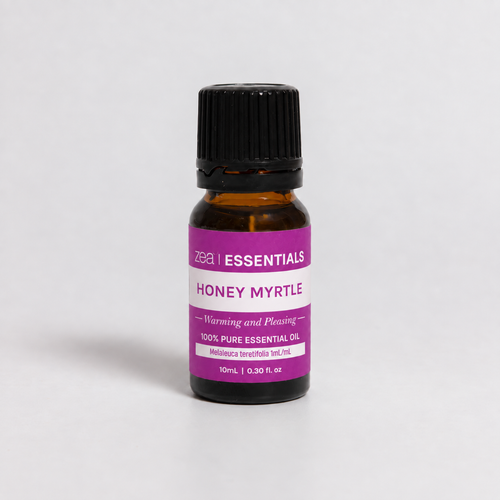
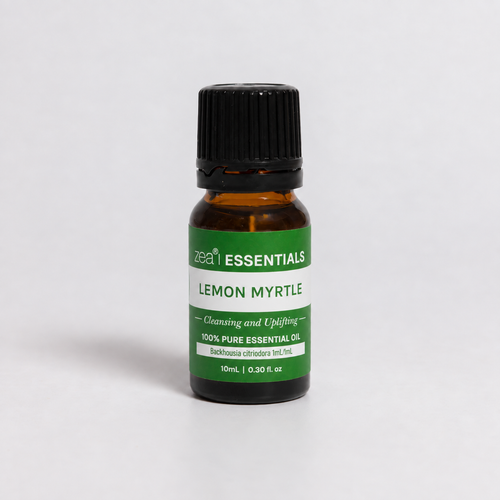
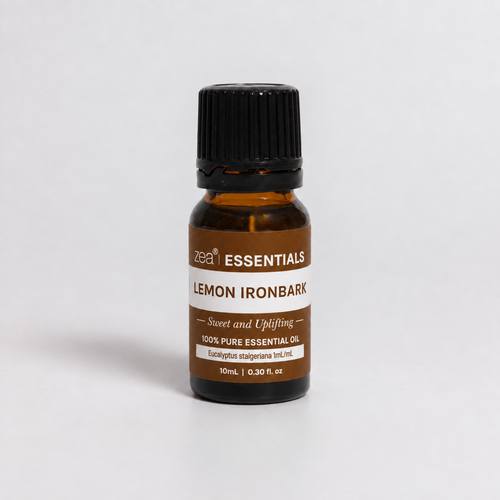
Honey Myrtle essential oil is steam distilled from Melaleuca teretifolia, a shrub or small tree native to the sandy heath and winter-wet swamps of south-west Western Australia. Its warm, honeyed citrus aroma often gets it filed alongside Lemon Myrtle, the other citrus-scented Australian native oil that shares "Myrtle" in its common name, but the two come from entirely different genera. Honey Myrtle is a Melaleuca; Lemon Myrtle is a Backhousia. Both sit in the same plant family, Myrtaceae, and both smell citrusy, but that is roughly where the resemblance ends. Untangling that naming overlap, and an even more surprising chemistry story hiding inside Honey Myrtle's own species, is what this guide sets out to do.

If you have ever assumed Honey Myrtle and Lemon Myrtle must be closely related because of the shared word in their names, or wondered why some Honey Myrtle descriptions sound almost identical to Lemon Myrtle's, the answer comes down to genus, chemotype and a common name that was never meant to double as a botanical classification.
Honey Myrtle at a glance
Here is the spec sheet for the plant and its oil before the naming problem and the three-way comparison.
| Feature | Detail |
|---|---|
| Botanical name | Melaleuca teretifolia Endl.1 |
| Plant family | Myrtaceae, the same family as Kunzea, Tea Tree, Eucalyptus and Lemon Myrtle |
| Genus | Melaleuca, a different genus from Lemon Myrtle's Backhousia |
| Plant part and method | Steam distilled, chiefly from the leaves and twigs2 |
| Native range | South-west Western Australia: Jarrah Forest and Swan Coastal Plain, including the Dandaragan Plateau, Northern Jarrah Forest and Perth subregions1 |
| Habitat | Sandy soils and clay, winter-wet depressions and swamps1 |
| Growth habit | Shrub or tree, 1 to 5 metres1 |
| Flowering | White, cream or pink flowers, chiefly October to December, with some populations flowering into January and March1 |
| Dominant constituents (citral chemotype) | Geranial 38.8%, neral 29.1%, myrcene 9.8%2 |
| Aroma | Sweet, honeyed citrus with a warm undertone |
| Blends well with | Lemon Myrtle, Lemon Ironbark, Kunzea, Lavender |
| Regulatory status (as sold by Zea) | Cosmetic essential oil, not a listed medicine |
Zea's own Honey Myrtle Essential Oil is distilled from this species and sits in the Australian native essential oils collection, alongside Zea's Lemon Myrtle and Kunzea ranges.
The Myrtle naming problem
"Myrtle" is doing a lot of quiet work in both of these names, and none of it is botanical. The true myrtle genus, Myrtus, is a small group of Mediterranean shrubs unrelated to either plant discussed here. Honey Myrtle and Lemon Myrtle both borrow "Myrtle" informally, the way common names often do, because they sit within the broader Myrtaceae family and share a citrus-leaning scent. Family membership is real: Myrtaceae also contains Eucalyptus, Tea Tree, Kunzea and Corymbia among thousands of other species. But family is a wide net. Within it, Honey Myrtle is classified in the genus Melaleuca, confirmed by the Western Australian Herbarium's FloraBase as Melaleuca teretifolia Endl.1, while Lemon Myrtle is classified in the genus Backhousia, described by the Atlas of Living Australia as endemic to eastern Australia and a close relative of the genus Choricarpia3. Two different genera, sharing one word in their common names, native to opposite sides of the country.
That distinction matters more than trivia. Honey Myrtle grows wild in the sandy heath and swampy flats of Western Australia's Jarrah Forest and Swan Coastal Plain regions, in the Dandaragan Plateau, Northern Jarrah Forest and Perth subregions1. Lemon Myrtle grows wild more than 3,000 kilometres away, in Queensland's east coast rainforest, from the Sunshine Coast regions of Eumundi, Maroochydore, Noosa and Woondum through to the ranges west of Miriam Vale and the Mackay, Whitsunday, Townsville and Herberton districts4. These are not two names for the same plant grown in two places. They are two unrelated trees from opposite ends of the continent that happen to share a common-name word and a family tree.

Three citrus-scented Australian natives, side by side
Honey Myrtle's closer, more useful comparison is not really Lemon Myrtle at all, since the two are unrelated beyond family membership. A fairer three-way comparison also brings in Lemon Ironbark, a Eucalyptus that gets confused with both for the same reason: another Myrtaceae native, another honeyed or lemon common name, another separate genus again.
| Feature | Honey Myrtle | Lemon Myrtle | Lemon Ironbark |
|---|---|---|---|
| Botanical name | Melaleuca teretifolia1 | Backhousia citriodora4 | Eucalyptus staigeriana5 |
| Genus | Melaleuca | Backhousia, endemic to eastern Australia4 | Eucalyptus (the ironbark group) |
| Native range | Sandy heath and swamps of south-west Western Australia1 | Queensland's east coast rainforest, Sunshine Coast to Herberton4 | A restricted pocket of far north Queensland5 |
| Dominant oil constituents | Geranial 38.8%, neral 29.1% (citral chemotype)2 | Citral 80 to 98%4 | Citral 34.32%, limonene 20.60%, 1,8-cineole 12.33%6 |
| Aroma character | Sweet, warm, honeyed citrus | Intensely, near-purely lemon | Softer, rounder, sherbet-like lemon |
| Sold by Zea | Yes, Honey Myrtle Essential Oil | Yes, Lemon Myrtle Essential Oil | Yes, Lemon Ironbark Essential Oil |
The genus row is the one worth remembering. Three separate genera, Melaleuca, Backhousia and Eucalyptus, all inside one family, all producing a citrus-adjacent essential oil, and all routinely lumped together in casual conversation as though they were variations on the same tree. They are not. We've covered Lemon Myrtle's full chemistry and uses in more depth in Benefits and Uses of Lemon Myrtle Oil, worth reading alongside this guide rather than instead of it. If this kind of naming untangling is useful, the Library has covered the same shape of problem before: Kanuka vs Kunzea vs Manuka Oil untangles three more Myrtaceae natives that get routinely swapped for each other despite being three separate genera again.
Why Honey Myrtle smells citrusy despite being a Melaleuca, not a Backhousia
Here is where Honey Myrtle gets genuinely interesting, and where its own species tells almost the same story as the genus-level confusion above, just one level down. Melaleuca teretifolia is not chemically uniform. Research collecting oil from wild Western Australian plants identified two distinct chemotypes within the one species: populations that look the same botanically but produce very different oil chemistry2.
One chemotype, described in the study as the "lemon form," yielded an oil rich in geranial (38.8%) and neral (29.1%), the two isomers that together make up citral, alongside a secondary fraction of myrcene (9.8%)2. Combined, that is a citral content of around 68%, and it is the source of Honey Myrtle's warm, honeyed lemon character. The other chemotype produced an almost entirely different oil, dominated by 1,8-cineole at 84.0%, with only small amounts of alpha-pinene, beta-pinene, limonene, terpinen-4-ol and alpha-terpineol making up the rest2. That second chemotype does not smell like citrus at all; it reads as sharp and medicinal, closer to Eucalyptus.
Zea's own Honey Myrtle Essential Oil, described on its own listing by its sweet lemon and honey character, corresponds to the citral-rich chemotype rather than the cineole-dominant one described above. It is a useful reminder that a correct botanical name does not guarantee one single, predictable chemistry, particularly in a genus as chemically variable as Melaleuca.
Aroma profile and blending
Honey Myrtle's citral-forward chemistry gives it a sweet, warm, honey-tinged citrus character, closer to a lemon and honey drink than a sharp lemon peel note. The myrcene fraction rounds the top note out further, adding a soft, slightly green warmth that keeps the oil from reading as a one-dimensional citrus blast. It is a gentler, rounder cousin to a straight lemon or Lemon Myrtle top note rather than a substitute for either.

That warmth is exactly why Honey Myrtle works well layered with other Australian natives rather than used as a lone citrus note. It sits comfortably alongside Lemon Myrtle and Lemon Ironbark for a layered citrus blend with three distinct personalities, softens a diffuser mix built around Kunzea, and pairs naturally with Lavender when a floral note is wanted alongside the citrus.
Practical use: dilution, patch testing and diffusion
Honey Myrtle is sold and used as a cosmetic essential oil, not a therapeutic product, so the guidance below is general good practice for essential oil use rather than a medical instruction.
- Dilute before topical use. Mix a small number of drops into a neutral carrier oil, such as jojoba or sweet almond oil, rather than applying Honey Myrtle neat to skin. (cited here only for its GC-MS constituent data, not its antifungal findings)
- Patch test first. Apply a small diluted amount to an inconspicuous area of skin, such as the inner forearm, and wait 24 hours before wider use.
- Avoid broken or irritated skin. As with all essential oils, keep it away from eyes, mucous membranes and compromised skin.
- Check with a health professional if pregnant, breastfeeding, or using on children. Essential oil safety data varies by life stage, and a GP or qualified aromatherapist is best placed to advise.
- Store away from direct sunlight and heat to preserve the oil's aroma and stability over time.
None of this makes Honey Myrtle a therapeutic product. It is sold and used as a cosmetic essential oil, valued for its aroma and blending qualities, not as a treatment, cure or prevention for any named condition. If you would like to understand how a supplier verifies that a bottle labelled with a specific species genuinely contains the oil it claims, rather than a cheaper substitute or a diluted blend, How Essential Oil Purity Is Verified covers GC/MS testing and Certificates of Analysis in detail.
Frequently asked questions
What is Honey Myrtle essential oil?
Honey Myrtle essential oil is steam distilled from Melaleuca teretifolia, a shrub or small tree native to the sandy heath and winter-wet swamps of south-west Western Australia1. Depending on the chemotype it is distilled from, it can be citral-rich and citrusy or 1,8-cineole-rich and medicinal; Zea's Honey Myrtle Essential Oil is the citral-rich, honeyed lemon type2.
Is Honey Myrtle the same as Lemon Myrtle?
No. They come from different genera entirely: Honey Myrtle is Melaleuca teretifolia, while Lemon Myrtle is Backhousia citriodora, a rainforest tree endemic to Queensland's east coast34. Both share "Myrtle" in their common name and both sit in the Myrtaceae family, but that is the extent of the relationship.
What does Honey Myrtle smell like?
Sweet, warm and honeyed with a citrus lead, closer to a lemon and honey drink than a sharp lemon peel note. That character comes from a citral content of around 68% (geranial 38.8%, neral 29.1%) in the chemotype Zea's oil is drawn from, softened by a secondary myrcene fraction2.
Where does Honey Myrtle grow?
Wild in the sandy and clay soils of south-west Western Australia, in winter-wet depressions and swamps across the Jarrah Forest and Swan Coastal Plain regions, including the Dandaragan Plateau, Northern Jarrah Forest and Perth subregions1.
How do you dilute Honey Myrtle oil?
Mix a small number of drops of Honey Myrtle into a neutral carrier oil, such as jojoba or sweet almond oil, before any topical use, and patch test on a small area of skin first. It is not intended to be applied neat.
References
Sources open in a new tab so you don't lose your place.
- 1. FloraBase, Western Australian Herbarium, Department of Biodiversity, Conservation and Attractions (DBCA). Melaleuca teretifolia Endl. View source
- 2. Southwell, I., Russell, M., Smith, R.L., Brophy, J.J. & Day, J. Melaleuca teretifolia, A Novel Aromatic and Medicinal Plant from Australia. Acta Horticulturae 677:79-83, 2005. View source
- 3. Atlas of Living Australia. Backhousia citriodora F.Muell. View source
- 4. Southwell, I. Backhousia citriodora F. Muell. (Lemon Myrtle), an Unrivalled Source of Citral. Foods 10(7):1596, 2021. View source
- 5. Atlas of Living Australia. Eucalyptus staigeriana F.Muell. ex F.M.Bailey : Lemon-Scented Ironbark. View source
- 6. Pedrotti, C. et al. Antifungal activity of essential oil from Eucalyptus staigeriana against Alternaria alternata causing leaf spot and black rot in table grapes. Anais da Academia Brasileira de Ciências 94(2):e20200394, 2022. View source