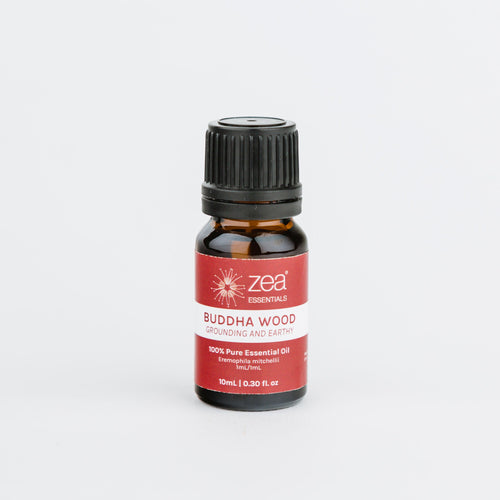
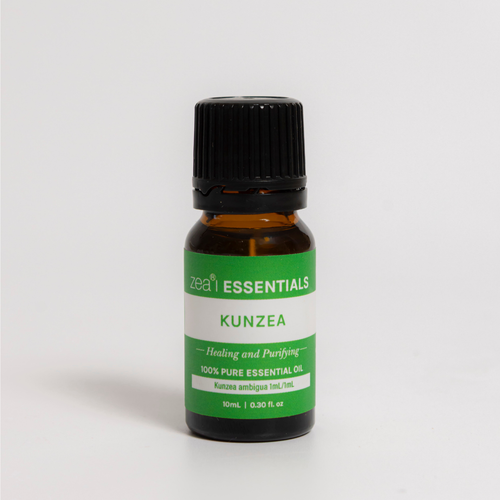
Buddha Wood essential oil is steam-distilled from the heartwood of Eremophila mitchellii, a shrub or small tree native to inland New South Wales and Queensland. It is prized in perfumery and aromatherapy for a deep, smoky, resinous, woody aroma used as a base note and fixative in blends, for grounding diffusion and meditation work, and in beard and skincare formulation. Despite one of its common names, "false sandalwood," it is not a Sandalwood at all: it belongs to a completely different plant family from true Sandalwood (Santalum species) and produces a different class of aromatic compounds. The name describes a similarity in smell, not a botanical relationship. You'll find the pure oil in Zea's Buddha Wood Essential Oil, alongside single-origin oils like Kunzea Oil from Tasmania in the wider range.
Botanical identity
Buddha Wood's chemistry and classification have shifted as botanists have re-examined the genus, so the table below reflects the current, verified placement rather than older references you may still see online.
| Detail | Buddha Wood |
|---|---|
| Botanical name | Eremophila mitchellii Benth. |
| Family | Scrophulariaceae (figwort family). Older references, and even some current retail listings, still say Myoporaceae. That family has been absorbed into Scrophulariaceae following taxonomic revision.1 |
| Common names | Buddha Wood, false sandalwood, bastard sandalwood, native sandalwood, budda, budtha |
| Plant part | Heartwood (the aromatic timber inside the trunk and larger branches) |
| Extraction method | Steam distillation of the wood |
| Region of origin | Semi-arid inland woodland of northern New South Wales and southern/central Queensland, Australia |
| Aroma profile | Deep, smoky, resinous, dry woody base note with a soft sweetness underneath |
| Main constituents | Eremophilanes - a rare class of bicyclic sesquiterpenoids - dominate the wood oil, principally eremophilone and related hydroxylated derivatives such as 2-hydroxyeremophilone and santalcamphor2 |
The genus Eremophila is large and chemically restless. A 2021 survey of 30 Eremophila taxa published in the journal Plants found the group so chemically variable across individual species and even individual plants that taxonomic identity alone has "limited predictive value" for what compounds a given specimen will contain1 - one reason lab-verified sourcing matters more with a native oil like this than with a mainstream, heavily standardised one.
What it smells like, and what it blends with
Buddha Wood sits at the deep end of the base-note register. Perfumers and aromatherapists describe it as smoky, dusty, resinous and dry, with a soft ambery warmth underneath the smoke - closer to a campfire ember than a fresh-cut timber. It has excellent tenacity, meaning it lingers on skin and in a blend long after brighter top notes have faded, which is exactly why it is used as a fixative: a small amount of Buddha Wood slows the evaporation of lighter oils and anchors the whole blend.
In a diffuser blend, Buddha Wood pairs naturally with other grounding and woody notes. Try it with Sandalwood-style or resinous oils, with citrus top notes (Lemon Myrtle, Bergamot) for contrast, or with our Root Chakra Blend and Meditation Lifestyle Blend, both of which lean on the same deep, settling character. In skin and beard formulation, its smoky woodiness is a natural partner for the native botanicals in Zea's Native Man Face and Beard Oil line.

Traditional and documented uses
What is documented in the modern chemistry literature is the wood's unusual sesquiterpene profile. The 2011 investigation that first mapped the wood, leaf, branch and root oils in detail found the wood oil dominated by eremophilanes, while the leaf oil was chemically distinct, led by spathulenol, alpha-pinene, globulol and viridiflorene.2 That chemical distinctness between plant parts is the practically useful point: the oil sold as Buddha Wood is the wood oil, and it is not interchangeable with a leaf distillation from the same tree.
Today, Buddha Wood's real, well-supported use case is straightforward: it is a fragrance and aromatherapy material valued for its scent and its fixative power in a blend, used in perfumery, diffusion and skincare formulation rather than as a medicine. If you want to see how it sits alongside the rest of Zea's native oil range, our roundup of 15 unique Australian essential oils covers the wider category.
How to use Buddha Wood essential oil
Diffusion
Add 3-5 drops to a standard ultrasonic diffuser with water, following your diffuser's own capacity guide. Because it is such a strong, persistent base note, Buddha Wood is often used sparingly and blended with one or two lighter oils rather than diffused alone.
Topical, diluted in a carrier oil
Buddha Wood should never be applied to skin undiluted. For general body use, a 2% dilution is a sensible starting point: roughly 12 drops of essential oil per 30ml (about 6 teaspoons) of a carrier oil such as jojoba, sweet almond or fractionated coconut oil. For facial or beard oil blends, drop to a 1% dilution (around 6 drops per 30ml of carrier). Always patch test on a small area of skin - such as the inner forearm - and wait 24 hours before wider use.
Bath
Essential oils do not dissolve in water on their own, so never add Buddha Wood directly to bath water. Disperse 4-6 drops into a tablespoon of a carrier oil, unscented bath dispersant, or full-fat milk first, then add that mixture to the running bath.

Safety
- Always dilute before topical use - see the ratios above.
- Patch test on a small area of skin and wait 24 hours before wider application.
- Avoid use during pregnancy and breastfeeding without guidance from a qualified healthcare practitioner, as with any concentrated essential oil.
- Keep out of reach of children. Do not apply to children's skin without professional guidance, and never diffuse continuously in a room with infants.
- Essential oils are not safe for cats, and caution is warranted around dogs and other pets - diffuse in a well-ventilated space the animal can leave, and never apply to a pet's skin or coat.
- Do not ingest. This is a fragrance and aromatherapy oil, not a supplement.
- Store away from direct light and heat, cap tightly closed.
Buddha Wood vs Australian Sandalwood vs Indian Sandalwood
This is where most confusion sits, and it is worth being precise about it: "false sandalwood" is a common name, not a family relationship. Wikipedia's own entry on the term lists Buddha Wood alongside three other, completely unrelated plants that all happen to carry the same nickname because of a similar scent1 - it is a smell-alike name, not a taxonomy.
| Detail | Buddha Wood | Australian Sandalwood | Indian Sandalwood |
|---|---|---|---|
| Botanical name | Eremophila mitchellii | Santalum spicatum | Santalum album |
| Family | Scrophulariaceae1 | Santalaceae3 | Santalaceae4 |
| Botanical relationship to true Sandalwood | None - different family, different aromatic chemistry (eremophilanes, not santalols). "False sandalwood" describes a smell similarity, not a relationship. | Genuine Sandalwood, same genus as Indian Sandalwood | Genuine Sandalwood, the classic reference species |
| Aroma character | Smoky, dusty, resinous, dry woody base note | Drier, sharper, more medicinal-woody than Indian Sandalwood | Creamy, soft, sweet, the "classic" rounded Sandalwood note |
| Sustainability / conservation status | Not internationally listed; regarded in parts of its native range as a woodland-invasive shrub rather than a scarce resource | IUCN Vulnerable. A 2021 review found wild populations declining across the western and southern rangelands after historical overharvesting, with plantation forestry now the recommended sustainable path forward3 | CITES Appendix II and IUCN Vulnerable in its native range, after decades of overharvesting in Asia. Increasingly supplied from cultivated plantations, including in Australia4 |
| Typical use | Fixative base note in perfumery, grounding diffusion, beard/skin oil blends | Perfumery, incense, carving, aromatherapy | Fine perfumery, incense, traditional skincare, aromatherapy |
| Price tier | Generally more accessible - it is not a CITES-restricted, high-demand global commodity | Mid-to-premium | Premium to very premium, reflecting scarcity and demand |
The practical takeaway: if you are chasing that classic creamy Sandalwood note, Buddha Wood will not deliver it - it is smokier and drier. If you want a robust, tenacious woody base to anchor a blend without the cost or sourcing pressure attached to genuine Sandalwood, Buddha Wood is worth exploring in its own right, alongside our wider Australian native essential oils range and the full essential oils collection.

Frequently asked questions
Is Buddha Wood the same as Sandalwood?
No. Buddha Wood (Eremophila mitchellii) belongs to a different plant family from true Sandalwood (Santalum species) and contains a different class of aromatic compounds. "False sandalwood" is a common name based on a similar smell, not a botanical relationship.1
What does Buddha Wood essential oil smell like?
Deep, smoky, resinous and dry, with a soft warmth underneath - closer to campfire embers than to the creamy sweetness of true Sandalwood.
Is Buddha Wood essential oil sustainable?
Yes, more so than either Sandalwood species compared here. Unlike Santalum album (CITES Appendix II, IUCN Vulnerable) and Santalum spicatum (IUCN Vulnerable, historically overharvested), Eremophila mitchellii carries no such international conservation listing and is considered a common, widespread shrub across its native range.3,4
Can I use Buddha Wood essential oil directly on my skin?
No. Always dilute it in a carrier oil first - around 1-2% depending on the use - and patch test before wider application.
What can I blend Buddha Wood with?
It works well with other woody and resinous notes, with citrus oils for contrast, and in grounding blends alongside oils like our Root Chakra Blend and Meditation Lifestyle Blend.
Does Buddha Wood have proven health benefits?
Buddha Wood is sold and used as an aromatherapy and fragrance material, not a therapeutic product. Laboratory studies have examined some of its isolated wood compounds in cell-culture settings,2 but that is not the same as a proven human health benefit, and no such claim is made for this oil.
References
- Sadgrove NJ, Padilla-Gonzalez GF, Green A, et al. The Diversity of Volatile Compounds in Australia's Semi-Desert Genus Eremophila (Scrophulariaceae). Plants. 2021;10(4):785. https://doi.org/10.3390/plants10040785
- Beattie KD, Waterman PG, Forster PI, Thompson DR, Leach DN. Chemical composition and cytotoxicity of oils and eremophilanes derived from various parts of Eremophila mitchellii Benth. (Myoporaceae). Phytochemistry. 2011;72(4-5):400-408. https://doi.org/10.1016/j.phytochem.2010.12.011
- McLellan RC, Dixon K, Watson DM. Prolific or precarious: a review of the status of Australian sandalwood (Santalum spicatum [R.Br.] A.DC., Santalaceae). The Rangeland Journal. 2021;43(4):211-222. https://doi.org/10.1071/RJ21017
- IUCN Red List of Threatened Species. Santalum album assessment. International Union for Conservation of Nature. https://www.iucnredlist.org/species/31852/9665066