Rosemary essential oil is steam-distilled from the leaves and flowering tops of Salvia rosmarinus (formerly classified as Rosmarinus officinalis), a woody Mediterranean shrub. It is sold under at least three distinct chemotypes - 1,8-cineole, camphor and verbenone - which differ in aroma, typical use and safety profile because the ratio of their dominant constituents varies significantly by growing region and climate.1 Reading the chemotype on the bottle matters more than the plain species name, because a camphor-dominant oil carries cautions that a verbenone-dominant oil does not.
Most rosemary oil sold at aromatherapy strength is cosmetic and inhalation-use only. It is not a registered therapeutic good, and - despite a wave of popular-media coverage - it is not a proven independent treatment for hair loss, memory, cognition or blood pressure. This guide covers what the chemotype labelling actually means, what the research does and does not show, and how to use rosemary oil safely.
Botanical identity
| Attribute | Detail |
| Botanical name | Salvia rosmarinus Spenn. (synonym: Rosmarinus officinalis L.) |
| Family | Lamiaceae (mint family) |
| Plant part used | Leaves and flowering tops |
| Extraction method | Steam distillation |
| Growing regions studied | Mediterranean native; commercial oil is also produced in Australia (Victoria), the USA, South Africa, Kenya, Nepal and Yemen1 |
| Aroma profile | Herbaceous, camphoraceous, woody-fresh, with a sharp medicinal top note |
| Main constituents | 1,8-cineole, camphor, verbenone, alpha-pinene and borneol, in ratios that vary by chemotype and origin1 |
Why rosemary has a genus problem: Salvia vs Rosmarinus

If you have seen rosemary oil labelled two different ways, that is not a labelling error. In 2017, a DNA sequencing study compared the genus Salvia against four smaller related genera, including Rosmarinus, and found they were not genetically distinct enough to justify separate genus names. Rather than split the much larger Salvia genus into several new genera (which would have required renaming over 700 species), the researchers proposed folding the five smaller genera into Salvia, renaming a far smaller number of plants.2
That is why rosemary's accepted botanical name is now Salvia rosmarinus, with Rosmarinus officinalis retained as a synonym. Both names refer to the same plant and the same oil - it is worth knowing if you are cross-checking ingredient lists, older textbooks or a supplier's certificate of analysis, since all three may still use the older name.
The three rosemary chemotypes
A "chemotype" is a chemically distinct variant of the same botanical species, produced when climate, altitude and soil shift which enzymes the plant favours during oil synthesis. A compositional study analysing rosemary oils from six countries, cross-referenced against 72 further published analyses, identified at least five chemotype clusters, with three appearing most often in commercial aromatherapy oil.1 Always check the chemotype (often abbreviated "ct.") on the label or certificate of analysis before buying for a specific purpose.
| Chemotype | Dominant constituent | Aroma | Typical use | Caution |
| ct. 1,8-cineole | 1,8-cineole (eucalyptol) | Sharp, fresh, eucalyptus-like | Diffusion for a fresh, invigorating room scent | Avoid direct inhalation with very young children; can be a respiratory irritant undiluted |
| ct. camphor | Camphor | Sharper, medicinal, more pungent | Diluted massage blends for tired muscles after activity | Documented in seizure case reports; avoid in epilepsy and pregnancy3 |
| ct. verbenone | Verbenone | Softer, sweeter, less sharp | Gentler skincare-oriented blends; the mildest of the three | Still patch test; less studied in isolation than the other two chemotypes |
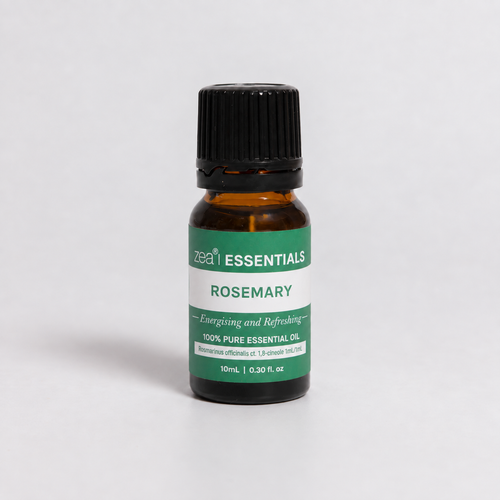
Zea's Rosemary Essential Oil sits within this family of oils and is intended for aromatherapy and cosmetic use, blended with a carrier oil or diffused, not for undiluted skin contact or ingestion.
What rosemary oil smells like and what it blends with

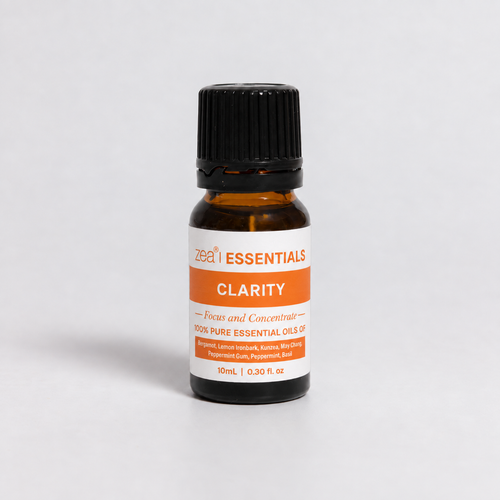
Rosemary reads as herbaceous and slightly medicinal on its own, which is why it rarely appears as a solo scent. It pairs well with citrus oils for a brighter, cleaner top note, with Lavender for a calmer herbal profile, and with woody oils like Cedarwood for depth. Zea's Clarity Lifestyle Blend and Focus & Clarity Essential Oil Trio both use rosemary alongside complementary oils for exactly this reason - it reads as "sharpening" against softer, sweeter notes rather than carrying a blend on its own.
Traditional and documented uses
Rosemary has a long history as a culinary herb and in traditional Mediterranean folk practice, associated with mental clarity and memory well before it was studied scientifically. In modern aromatherapy, rosemary oil is most commonly diffused for an invigorating, focus-associated scent, or diluted into massage blends aimed at tired muscles after activity.
It is important to separate traditional use from proven clinical effect. Much of the popular coverage of rosemary oil in recent years has focused on hair growth, memory and blood pressure. Zea does not make these claims, and the evidence for each is limited, mixed or simply absent for topical rosemary oil specifically - see the dedicated section below on the hair-growth research, which is the best-studied of these claims and still falls short of proving rosemary oil is an effective standalone treatment.
The hair-growth claim: what the research actually shows
Rosemary oil has a large presence in hair-care marketing and social media, almost always framed as a natural alternative to minoxidil. The primary study behind that claim is a 2015 randomised, single-blind trial that assigned 100 men with androgenetic alopecia to either rosemary oil or minoxidil 2% for six months.4 Both groups showed a statistically significant increase in hair count from baseline to the 6-month mark, but there was no significant difference in hair count between the rosemary and minoxidil groups at either the 3-month or 6-month assessment.4 Notably, neither group showed a significant improvement at the earlier 3-month checkpoint, and scalp itching increased in both groups over the trial, though it was more frequent with minoxidil.4
Read carefully, this trial shows rosemary oil performed similarly to minoxidil 2% within this one study of a specific patient group over six months - it did not include an untreated or placebo-oil control group, so it cannot show that rosemary oil outperforms doing nothing. It is one trial with a moderate sample size, not a body of confirmatory evidence, and it does not establish rosemary oil as a proven treatment for hair loss on its own. Zea does not sell Rosemary Essential Oil as a hair-growth product, and this article makes no hair-growth, alopecia, memory, cognition or blood pressure claim for it.
How to use rosemary oil
- Diffusion: 3-5 drops in an ultrasonic diffuser with water, run for 30-60 minutes at a time in a well-ventilated room. See Zea's range of aromatherapy diffusers.
- Topical dilution: A standard adult dilution is 2-3%, roughly 12-18 drops of essential oil per 30mL of carrier oil such as Zea's Unscented Massage Carrier Oil. Never apply rosemary oil to skin undiluted.
- Hair and scalp use: If you want to add rosemary oil to a hair-care routine, do so as a diluted rinse-through or blended into a shampoo base rather than applying neat to the scalp. Zea's 2-in-1 Natural Citrus Hair & Body Shampoo is a gentler starting point for scalp-adjacent use.
- Bath: Disperse 4-6 drops in a tablespoon of carrier oil or an unscented dispersant before adding to bath water, since undiluted essential oil floats and can irritate skin directly.
New to blending ratios generally? Our guide to diluting essential oils sets out the ratios, the drops-per-millilitre maths and the carrier oils in one place, and our Essential Oils 101 guide covers the wider basics.
Safety
- Dilute before skin contact. Undiluted rosemary oil can irritate skin and mucous membranes.
- Patch test first. Apply a diluted drop to the inner forearm and wait 24 hours before wider use.
- Epilepsy caution. Camphor-type rosemary oil is named among eleven essential oils documented in case reports of plant-induced seizures in otherwise healthy adults and a child, attributed to reactive monoterpene ketones including camphor and cineole.3 People with a seizure disorder should avoid camphor-chemotype rosemary oil, and should discuss any essential oil use with their doctor.
- Pregnancy caution. Rosemary oil, particularly the camphor chemotype, is commonly advised against during pregnancy due to its stimulant and potentially convulsant constituents. Speak to your doctor or midwife before using it if you are pregnant.
- Children and pets. Keep rosemary oil, diluted or not, out of reach of young children and away from cats, whose liver enzymes process essential oil constituents poorly.
- Not for ingestion. Rosemary essential oil sold for aromatherapy is not formulated or labelled for internal use.
Frequently asked questions
Is Rosmarinus officinalis the same as Salvia rosmarinus?
Yes. They are the same plant. Salvia rosmarinus is the botanical name accepted since a 2017 DNA-based reclassification; Rosmarinus officinalis is now treated as a synonym and still appears widely in older references and some current labelling.2
What is the difference between the three rosemary chemotypes?
They are the same species grown in different conditions, producing oil with a different balance of constituents - 1,8-cineole, camphor or verbenone as the dominant compound - which changes the aroma, typical use and safety profile of the oil.1
Does rosemary oil regrow hair?
One randomised trial found rosemary oil performed comparably to minoxidil 2% on hair count over six months in men with androgenetic alopecia, with no significant difference between the two treatments and no placebo-oil comparison group.4 That is not the same as proof rosemary oil independently regrows hair, and Zea does not make that claim for its Rosemary Essential Oil.
Is rosemary oil safe during pregnancy?
Rosemary oil, especially the camphor chemotype, is generally advised against during pregnancy because of its stimulant and potentially convulsant properties. Check with your doctor or midwife first.
Can rosemary oil trigger seizures?
Camphor-type rosemary oil is one of eleven essential oils named in a case series of plant-induced seizures in people with no other cause of epilepsy found.3 Anyone with a seizure disorder should avoid it and discuss essential oil use with their doctor.
How do I dilute rosemary oil for topical use?
A standard adult dilution is 2-3%, which works out to roughly 12-18 drops of essential oil per 30mL of a carrier oil.
References
Sources open in a new tab so you do not lose your place.
- 1. Satyal P, Jones TH, Lopez EM, et al. Chemotypic Characterization and Biological Activity of Rosmarinus officinalis. Foods. 2017;6(3):20. View source
- 2. Drew BT, González-Gallegos JG, Xiang CL, et al. Salvia united: The greatest good for the greatest number. Taxon. 2017;66(1):133-145. View source
- 3. Burkhard PR, Burkhardt K, Haenggeli CA, Landis T. Plant-induced seizures: reappearance of an old problem. Journal of Neurology. 1999;246(8):667-670. View source
- 4. Panahi Y, Taghizadeh M, Marzony ET, Sahebkar A. Rosemary oil vs minoxidil 2% for the treatment of androgenetic alopecia: a randomized comparative trial. Skinmed. 2015;13(1):15-21. View source