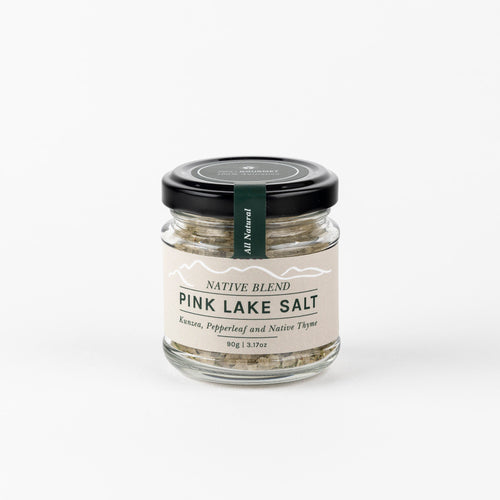
Native Pink Lake Salt is a hand-blended Australian seasoning built around pink lake salt, harvested from Australia's inland salt lakes, combined with dried Kunzea leaf, Mountain Pepperleaf, Saltbush and Native Thyme. The pink colour is not a mineral, a dye or a marketing flourish - it is the visible trace of the same natural process that turns several of Australia's inland salt lakes a genuine shade of pink: a community of salt-loving microorganisms living in the brine. This article is written for the kitchen rather than the supplement shelf - what the salt actually is, why it is pink, how it compares to the salt already in your pantry, and how to use it so both the crystal and the herbs earn their place on the plate.

Where the pink colour actually comes from
Salt lakes do not turn pink because of a mineral in the salt itself. They turn pink because of what lives in the water before it is ever harvested. Hypersaline lakes and salt evaporation ponds around the world, including several in Australia, can support two pink-pigmented organisms at once: a microscopic alga called Dunaliella salina, and a community of halophilic archaea (single-celled microorganisms adapted to extreme salt) from the family Halobacteriaceae.1
Dunaliella salina is well known for producing beta-carotene, the same pigment that colours carrots, as protection against intense sunlight in such an extreme environment. But according to a peer-reviewed review of the ecology of Dunaliella in high-salt environments, the alga is not actually the main source of a lake's visible colour. Its beta-carotene is packaged tightly inside the alga's single chloroplast, out of view, while the halophilic archaea sharing the same water carry their pigment - a carotenoid called bacterioruberin - spread across their outer cell membrane, where it is far more visible. The review states plainly that beta-carotene "contributes relatively little to the overall color of the brine, which is dominated by bacterioruberin of the Archaea."1
Australia has real, documented examples of this. The same scientific review names Lake Tyrrell, an ephemeral salt lake in Victoria, and Hutt Lagoon, a hypersaline lagoon in Western Australia where Dunaliella salina is farmed commercially for beta-carotene production. A third Victorian lake, simply named Pink Lake, is mentioned as well.1 Exactly how pink a lake looks on any given day depends on salinity, temperature, sunlight and which of these microorganisms currently has the upper hand - which is also why salt harvested from a pink lake is typically a soft blush or salmon hue rather than a uniform, saturated pink. Once the brine evaporates and the salt crystallises, what is left behind is a pale natural tint, not an added pigment.
How pink lake salt compares to the salt already in your pantry
Colour is the headline, but crystal size and how the salt is processed matter more for how it actually cooks. Here is how pink lake salt sits alongside the other salts most home cooks already have in the pantry.
| Salt type | How it is made | Crystal & texture | Best culinary use | When not to use it |
|---|---|---|---|---|
| Pink lake salt | Harvested from Australian inland salt lake brine, sun and wind evaporated, hand-collected with minimal processing | Coarse, irregular, multi-textured flakes and grains; pale blush to salmon colour, naturally variable batch to batch | Finishing roasted vegetables and meat, gifting, rubs where crunch and texture matter | Baking or any recipe that measures salt by volume against a fine-grain standard |
| Table salt | Mined halite, refined, ground fine, usually iodised with an anti-caking agent added | Very fine, uniform white grains that dissolve almost instantly | Baking, brining and anywhere a recipe needs predictable, fast, even seasoning | Finishing - it dissolves before you taste any crunch, and some people find the additives leave a flat aftertaste |
| Rock salt | Mined directly from underground deposits and sold as large, minimally processed chunks or crystals | Large, hard, irregular chunks; colour ranges from white and grey to pink or amber depending on the deposit | Grinding fresh at the table in a salt mill, or packing around a whole fish or bird for a salt-baked crust | Anywhere the salt needs to dissolve quickly and evenly into a liquid |
| Flaked sea salt | Evaporated seawater, harvested as thin, pyramid-shaped flakes | Light, brittle, flat flakes that crush easily between the fingers | Finishing salt - it dissolves quickly on the tongue and adds a pleasant crunch and pop | High-volume everyday cooking, where its price and delicate texture are wasted |
How to use Native Pink Lake Salt in the kitchen

Finishing, not fine baking
Because the crystal is coarse and irregular rather than fine and uniform, pink lake salt is at its best as a finishing salt - added at the end of cooking or right before serving, rather than dissolved early in a sauce or measured precisely into a baked good. Sprinkled over a dish just before it reaches the table, the crystal keeps its bite and the herb flecks (Kunzea, Pepperleaf, Saltbush, Native Thyme) stay fragrant rather than cooking out over heat. Because the crystal is bulkier than table salt, a pinch goes further by volume than you might expect - start with less than you would with fine salt and taste as you go.
Grinding it
The blend's dried herb content makes it a poor fit for a standard pepper-style grinder, which is built for hard, uniform crystals rather than a mix of salt and leaf. Dispensing it by hand or with a small spoon keeps the herb pieces intact and avoids jamming a mechanism designed for something else.
Pairing with the native blend
Because Kunzea, Mountain Pepperleaf, Saltbush and Native Thyme are already folded through the salt, it does double duty as both seasoning and salt in one step. It suits roasted potatoes and root vegetables, grilled or roasted meat, fresh bread and crackers, and simple dishes like eggs where a single, considered seasoning is all that is needed.
See it in the recipes

Two Zea Gourmet recipes already put this exact blend to work, and both are worth a look as concrete, worked examples rather than repeating the theory here. Easy Pink Lake Salt Crackers uses the coarse crystal as a finishing salt pressed into the dough before baking, so it stays visible and crunchy on the surface rather than disappearing into the mix. Crispy Kunzea & Pink Lake Salt Potatoes shows the finishing approach from the section above in practice: the salt goes on at the end, once the potatoes are already crisp, so the crystal and the herbs are the last thing you taste rather than the first thing that cooks off.
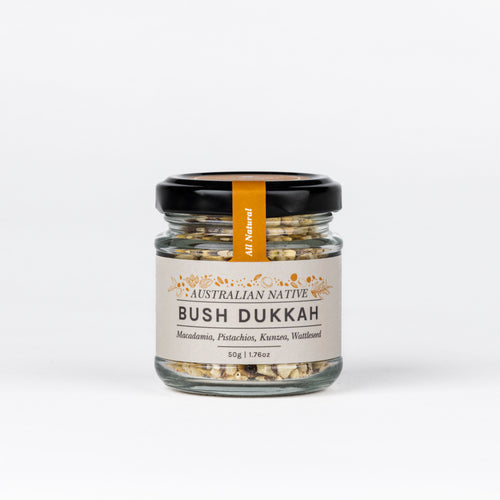
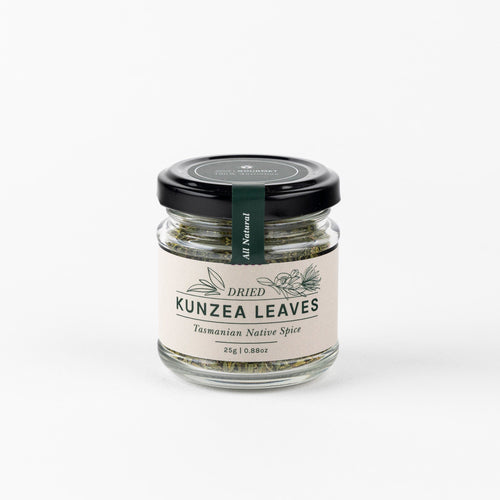
If you are building out a native pantry rather than buying one jar at a time, Dried Kunzea Leaf is the same ingredient used loose, and Australian Native Bush Dukkah is a natural next seasoning to shake over the same roasted vegetables or bread. Both sit alongside Kunzea Honey in Zea's wider Zea Gourmet Pantry range, and if dukkah is new to your kitchen, Dukkah Marinated Spring Veggies is a simple place to start. As with the rest of the Zea Gourmet range, Native Blend Pink Lake Salt is made by Zea, a Certified B Corporation.
A note on salt and your diet, generally
Whatever colour it is and wherever it comes from, salt is sodium chloride, and general dietary guidance on sodium applies to all of it equally. Food Standards Australia New Zealand recommends adults aim for around 2,000mg of sodium a day, roughly equivalent to 5g of salt or about a teaspoon, and advises choosing foods lower in salt more broadly.2 That guidance applies to any salt in your pantry, this one included - it is a general reminder to season with a normal hand, not a reason to treat one salt as different from another.
Frequently asked questions
What is pink lake salt?
Pink lake salt is salt harvested from the brine of naturally pink inland salt lakes, rather than mined rock salt or evaporated seawater from the ocean. Zea's Native Blend Pink Lake Salt combines it with dried Kunzea leaf, Mountain Pepperleaf, Saltbush and Native Thyme.
Why is the salt pink?
The pink colour comes from microorganisms living in the lake's brine before harvest, mainly halophilic archaea pigmented with the carotenoid bacterioruberin, alongside the beta-carotene-producing alga Dunaliella salina. It is a natural biological process, not a mineral in the salt or an added colour.1
Is pink lake salt the same as Himalayan salt?
No - they are different products from different processes. Himalayan salt is a rock salt mined from ancient inland sea deposits, with its pink to reddish colour coming from trace minerals within the rock itself. Pink lake salt is harvested from the brine of a modern salt lake, where the colour comes from living microorganisms in the water rather than the mineral content of the rock.
How do you use pink lake salt in cooking?
Best as a finishing salt: added at the end of cooking or just before serving, so the coarse crystal keeps its crunch and any herbs in the blend keep their fragrance. It suits roasted vegetables, grilled meat, fresh bread and simple dishes like eggs.
Can you cook with it, or is it only for finishing?
It can go into a dish earlier in cooking, in a rub or seasoning mix, but it is not the right choice for baking or any recipe that measures salt precisely by volume, since its coarse, irregular crystal does not behave like fine table salt. For those uses, a fine-grain salt is more practical, and pink lake salt is better saved for where its texture and colour can actually be seen and felt.
References
- Oren A. The ecology of Dunaliella in high-salt environments. Journal of Biological Research-Thessaloniki, 2014;21:23. PubMed Central PMC4389652. DOI: 10.1186/s40709-014-0023-y
- Food Standards Australia New Zealand. Sodium and salt. foodstandards.gov.au/consumer/nutrition/sodium-salt/about-sodium-salt